- Digital Surfer
- Posts
- What Happened After I Started Publishing Again
What Happened After I Started Publishing Again
AI Mode vs AIO; Bing Spills on Duplicate Content; GSC With AI; Local AI Search; AI Fails; ChatGPT Images; ChatGPT Apps Open; Netflix and Podcast; and Much More!

Yoyao
December 20, 2025 • Est. Learning Time: 8 minutes
In partnership with

FIRST …
After a long stretch of no publishing, I pushed a small cluster of tightly scoped articles live over the past several days.
This coincided with releasing Floyi’s Content Creation workflow, which removed friction from publishing directly against the topical map.
Within days of publishing resuming, the number of topics from the topical map ranking in the top 20 began increasing.

Not traffic, not wins yet. Still early. Just clear topic-level expansion after weeks of flat movement.
This was driven by publishing against a defined topical map, not a keyword-first workflow. It is not magic. It’s what happens when structure meets execution.
Happy Holidays. I hope the end of your year is calm, clear, and gives you a chance to step back and see what actually moved the needle.
AD
Want to get the most out of ChatGPT?

ChatGPT is a superpower if you know how to use it correctly.
Discover how HubSpot's guide to AI can elevate both your productivity and creativity to get more things done.
Learn to automate tasks, enhance decision-making, and foster innovation with the power of AI.
SEO + GEO
Ahrefs’ Despina Gavoyannis and Xibeijia Guan analyzed 730,000 paired answers and found Google’s AI Mode is not just a longer AI Overview. The two systems usually land on the same conclusion, but they get there with different wording and different sources, which means “ranking” in one does not guarantee visibility in the other.
Citation overlap: 13.7% of cited URLs overlapped between AI Mode and AI Overviews
Top-3 citation overlap: 16.3%
Word-level overlap: 16% unique-word overlap (Jaccard 0.16)
Same first sentence: 2.51% of the time
Identical responses: 0.51% of cases
Semantic similarity: 86% average; 89.7% scored above 0.8
AI Mode responses are ~4x longer on average
AI Mode includes ~3.3 entities vs 1.3 in AI Overviews (about 2.5x more)
If your brand appears in AI Overviews, there’s a 61% chance it also appears in AI Mode
My Take: These numbers back what I’ve been saying earlier this year about the lack of overlap between AI Mode, AI Overviews, Google SERPs and others. In the image below that I shared months ago, you can see how little overlap there is between AI Mode and Google/Bing SERPs and other AI search engines.

Fabrice Canel and Krishna Madhavan from Microsoft Bing explain duplicate content is less a “penalty” problem and more a “signal blur” problem. Some of the key takeaways:
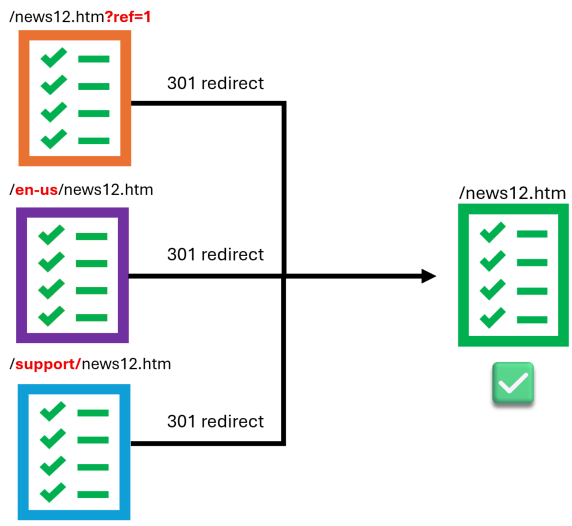
Duplicate content does not trigger penalties by itself, but it can reduce visibility.
Multiple versions split signals like clicks, links, impressions and engagement.
Duplicates create ranking uncertainty, so the wrong URL can surface.
Crawl budget gets wasted revisiting duplicates instead of discovering fresh pages.
AI systems cluster near-duplicate URLs and pick one representative page, sometimes the outdated page because the intent signals are muddy.
Near-identical variants blur intent signals, reducing odds your preferred page is used.
Syndication can confuse source attribution across domains; ask partners to canonical to you.
Campaign variants should be canonicalized unless intent meaningfully changes.
Localization should change substance, not just swap place names; use hreflang for targeting.
Use 301s, canonicals, noindex and IndexNow to consolidate and speed updates.
Vince Nero dug into robots.txt files from 100 top US and UK news sites to see who is blocking AI bots and why it matters for PR and SEO. His headline stat: 79% block at least one training crawler, 71% block at least one live retrieval bot, and 67% block PerplexityBot. The move for marketers is not to blacklist these publishers. Instead, check which bots a site blocks, remember robots.txt is only a request, and prioritize earning coverage on authoritative outlets anyway. Build stories that travel across channels, not just links. If you want blocking, publishers do it at CDNs.

Google introduced an experimental AI-powered configuration in Search Console’s Performance report that turns plain-English questions into the filters, comparisons, and metrics you need. Instead of clicking through menus, you can ask for things like phone queries containing “sports” over six months, this quarter vs. last year for URLs with /blog, or CTR and position for Spain over 28 days. The tool auto-picks Clicks, Impressions, CTR, or Position to match your prompt, helping you reach insights faster. It’s rolling out to a limited set of sites, so double-check settings since AI can misread intent and it cannot sort or export.

Francine Monahan digs into Yext’s analysis of 6.9M AI citations across ChatGPT, Gemini, and Perplexity and the message is clear: local AI visibility is probabilistic, but you can stack the odds. Treat location as the lens, build dedicated pages for geographies you serve, and make your facts easy to verify across the web. Keep your website and listings airtight, since they are the most “controllable” citation sources, and reinforce key attributes in directories, maps, and trusted third parties. Do not block AI crawlers if you want to be found.
SEO + GEO Ripples
John Mueller and Danny Sullivan tackle the acronym circus around AI search, AEO, GEO, AIO, and “LMNOPO” on the Search Off the Record podcast. Their point: stop renaming the job. AI answers and AI Mode are just formats inside SEO, not a separate sport. They explain why you can rank in blue links yet miss an AI overview: the system fans out into related queries and builds context. The playbook stays boring on purpose: write for humans, add original experience, support it with images or video, and track quality conversions, not raw clicks.
Google is suing SerpApi for allegedly bypassing security protections to scrape copyrighted content that appears in Google Search. In this post from Google’s General Counsel, they argue responsible crawlers follow industry norms and respect a site’s directives, while “stealthy scrapers” override those choices and take content at scale (sounds familiar). They claim SerpApi uses cloaking, bot networks and constantly changing crawler identities to evade defenses, then resells scraped outputs for a fee, including content Google licenses from third parties such as images in Knowledge Panels and real-time data in Search features. Google says it spends heavily to stop this abuse, and that legal action becomes the last resort when technical measures are repeatedly circumvented.
Matt G. Southern reports that Google quietly clarified a common JavaScript SEO trap: if the initial HTML includes a noindex tag, Googlebot may skip rendering, so your JavaScript never runs and the page stays out of the index. If you rely on JS to remove noindex after content loads or an API succeeds, you are gambling with visibility. So do not ship noindex in the first response for pages you might want indexed. Handle failure states server side with proper status codes, and audit templates to ensure robots meta is correct before the crawler arrives every time.
AI
Rob Glover rounds up 2025’s funniest and scariest AI blunders, then turns the blooper reel into a playbook. His lesson: AI is confident, not correct, so treat outputs like drafts, not facts. Write prompts with a clear goal, desired format, warnings, and the context the model needs. Keep sensitive data out of chatbots, or disable training and set an internal policy. Demand sources, click them, and add a “no made-up facts” guardrail, especially for health, legal, and finance. When stakes rise, use tools with stronger research modes and still have a human verify before you ever ship anything to customers.
OpenAI introduces a revamped ChatGPT Images model that makes photo edits stick to your instructions while keeping lighting, composition, and faces consistent. The big win for marketers: faster iteration, up to four times quicker generations, plus better text rendering for ads, mock newspapers, infographics, and UI screenshots. Use the new Images space in the ChatGPT sidebar to test preset styles and trending prompts, and upload your likeness once to reuse later. In the API, GPT Image 1.5 improves logo and key visual preservation and cuts image I/O costs about 20%, making catalog and campaign variant generation easier for busy teams.
My Take: Impressive and now I’m using both ChatGPT Images and Gemini Nano Banana to see which is a better fit for the job. Below are images from both with the prompt: “Create a charmingly scientific infographic on The Floyi Closed Loop System that a parent can read to a child.” It’s crazy how well both do with copy.

Nano Banana

ChatGPT Images
OpenAI is now open for submission of ChatGPT apps, letting your tool show up in the new in product app directory and be invoked with an @ mention. Build with the beta Apps SDK, but start by reading the submission guidelines early so you design for real user intent and avoid rework. When ready, submit in the Developer Platform with MCP connectivity details, testing steps, directory metadata, and country availability. For now, monetize by linking to your own checkout, with more options coming next year, too.
AI Ripples
OpenAI released GPT-5.2-Codex, an agentic coding model tuned for long projects, big refactors, and safer defense work. OpenAI reports state-of-the-art results on SWE-Bench Pro (56.4% accuracy) and Terminal-Bench 2.0 (64.0%), plus stronger vision for reading screenshots and mocks.
Gemini 3 Flash was released and is now the default in the Gemini app and rolling into AI Mode in Search, plus it is available to developers via the Gemini API in Google AI Studio, Vertex AI, and Gemini CLI. They say to use it for fast, iterative coding, real-time multimodal analysis, and interactive apps where latency kills engagement.
MARKETING
TechCrunch’s Amanda Silberling reports that Netflix is snapping up exclusive video rights to podcasts, aiming straight at YouTube’s living room dominance. Podcasts are soaking up huge background time, and Netflix wants that “always on” attention inside its app. Creators in the story are split. Some see video as extra work with little audience payoff, especially if listeners prefer audio. Test audio vs. video performance, protect your production schedule, and only invest in video when it clearly improves reach, retention, or monetization.
Anil Chitrapu explains how Wirecutter built “Wirecutter For You,” a weekly personalized newsletter, fast, without letting algorithms hijack editorial judgment. The team chose email as a controlled sandbox to test personalization, protect inbox trust, and learn before changing the site experience. They started with a tightly curated, editor-approved content pool, then scored stories using three lightweight signals: what you read, what’s fresh, and what’s trending. Under the hood, embeddings map articles into a similarity space so the system can recommend nearby topics, not just repeat what readers already clicked. Ship narrow, measure reader trust, and design guardrails first so personalization feels like better editing, not automation.
SOCIAL MEDIA
Yongi Barnard explains why most brands should skip a subreddit unless customers already chatter, you can show up daily, and you have a Reddit native moderating. Start by validating demand with Reddit search for category subs and recurring product questions. Pick one primary goal: customer care, community advocacy, or brand presence, then staff and document tone, disclosure, and escalation rules. Set up the space on desktop, choose topics, go public, and make it look official with logo and banner. Launch with a pinned welcome post, starter threads, and superfans. Stay alive by replying quickly, running rituals, and embracing criticism transparently.
TOOLS AND RESOURCES
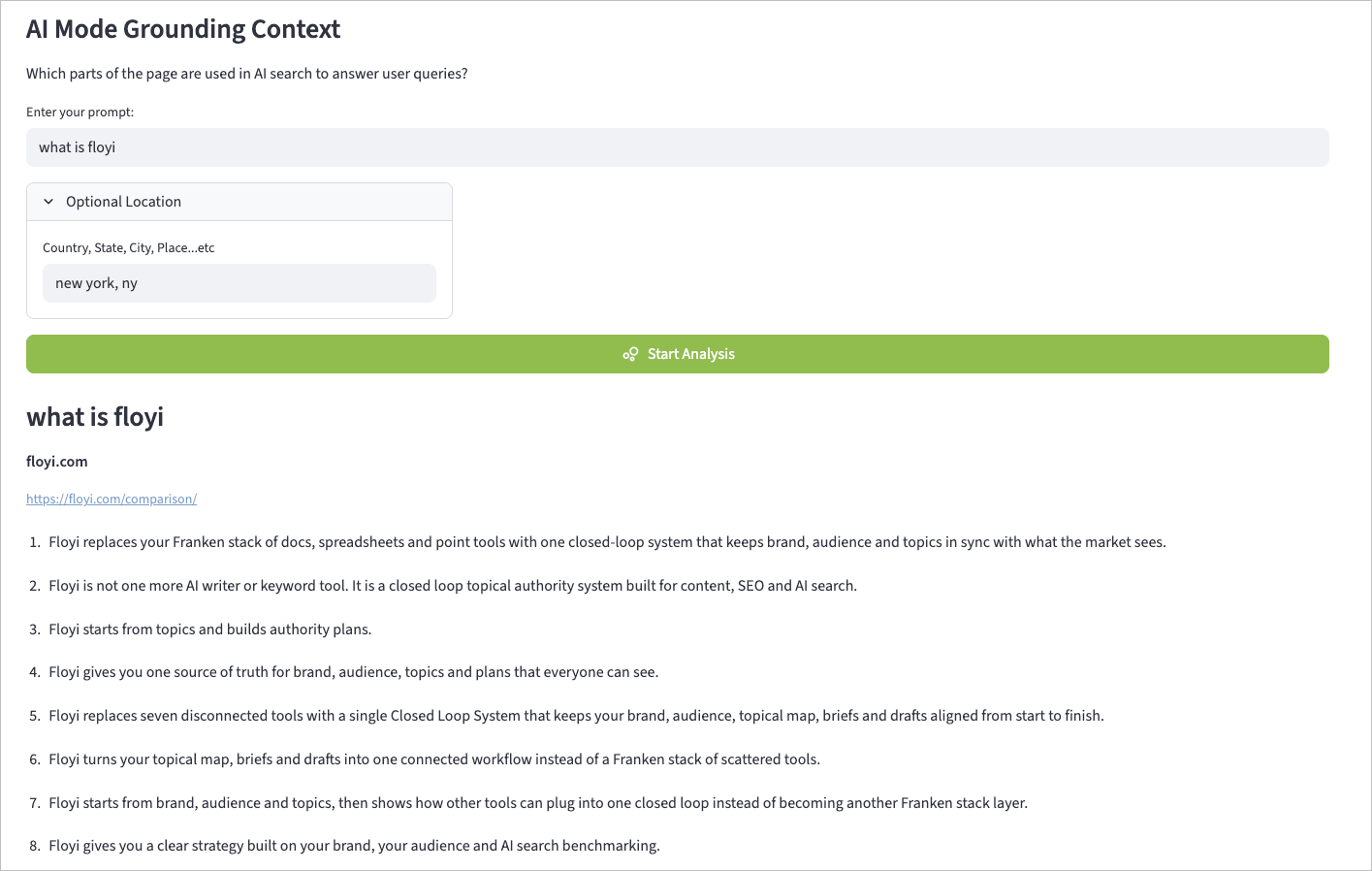
Dan Petrovic explains why “ranking” is no longer the same as “being seen” in AI search, and he offers a simple fix: watch what the AI actually reads. His Grounding Snippet Tool shows which URLs Gemini pulls into answers and the exact sentences it extracts as “grounding chunks.” That view makes optimization brutally clear. If the wrong lines get pulled, you rewrite and reposition. If competitors get more chunks, you study their structure and out-write them. Run your target query, add a location if it matters, then rebuild pages so your best, most self-contained statements show up early and match the fan-out angles the model is chasing.
My Take: It’s a nice tool that you can use for some quick analysis for sure. Here’s one I ran for Floyi -
WAYS WE CAN WORK TOGETHER
Floyi - The only AI-powered tool that builds 4-level topical maps. Don’t just plan your content strategy - make it unstoppable.
TopicalMap.com Service - Let us do the heavy lifting. We handle the research, structure, and strategy. You get a custom topical map designed to boost authority and dominate your niche and industry.
Topical Maps Unlocked 2.0 - Unlock the blueprint to ranking success. Master the art of structuring content that search engines (and your audience) love - and watch your rankings soar.
AD
Shoppers are adding to cart for the holidays

Over the next year, Roku predicts that 100% of the streaming audience will see ads. For growth marketers in 2026, CTV will remain an important “safe space” as AI creates widespread disruption in the search and social channels. Plus, easier access to self-serve CTV ad buying tools and targeting options will lead to a surge in locally-targeted streaming campaigns.
Read our guide to find out why growth marketers should make sure CTV is part of their 2026 media mix.
What Did You Think of This Week's Wave? |
LIKE DIGITAL SURFER?
Find me and others in the Digital Surfer Discord community.
I’d also love to know what you think and if you have any ideas for the newsletter. Reply or email me at [email protected].
I’d also appreciate it if you shared it with fellow digital surfers.
You currently have 0 referrals, only 3 away from receiving LinkedIn Shout-out.
Have a great week taking your SEO and digital marketing to another level!
And don’t forget to drag the Digital Surfer emails to your Primary Inbox 🌊
Reply