- Digital Surfer
- Posts
- Gemini Name-Dropped Us. I Took Notes.
Gemini Name-Dropped Us. I Took Notes.
Wave 271; 2026 SEO Budgeting; Content Publish Dates Matter; Image SEO Has Changed; News Publishers Lost 25% of Google Traffic; and Much More!

Yoyao
December 27, 2025 • Est. Learning Time: 7 minutes
In partnership with

FIRST …
I was talking to a Floyi user this past week, and he mentioned how he found us: Gemini suggested Floyi.
He was building a topical map and a sitemap for his company. He started in Gemini, like many do. Prompt, refine, prompt again. The output looked “detailed,” but it did not hold a stable structure. It kept drifting.
Then Gemini said, “Use Floyi.”
So I ran a quick test. I opened an incognito window, stayed logged out, and asked one question: “What is Floyi?”
Gemini described Floyi as an AI-powered content strategy and SEO platform for building topical authority. It positioned Floyi for traditional search engines like Google and AI answer engines. It even noted Floyi’s early-2025 launch timing. Then it listed key capabilities in plain English: topical maps, AIRS (AI Results) analysis, brand and persona foundation, content briefs and keyword clustering.
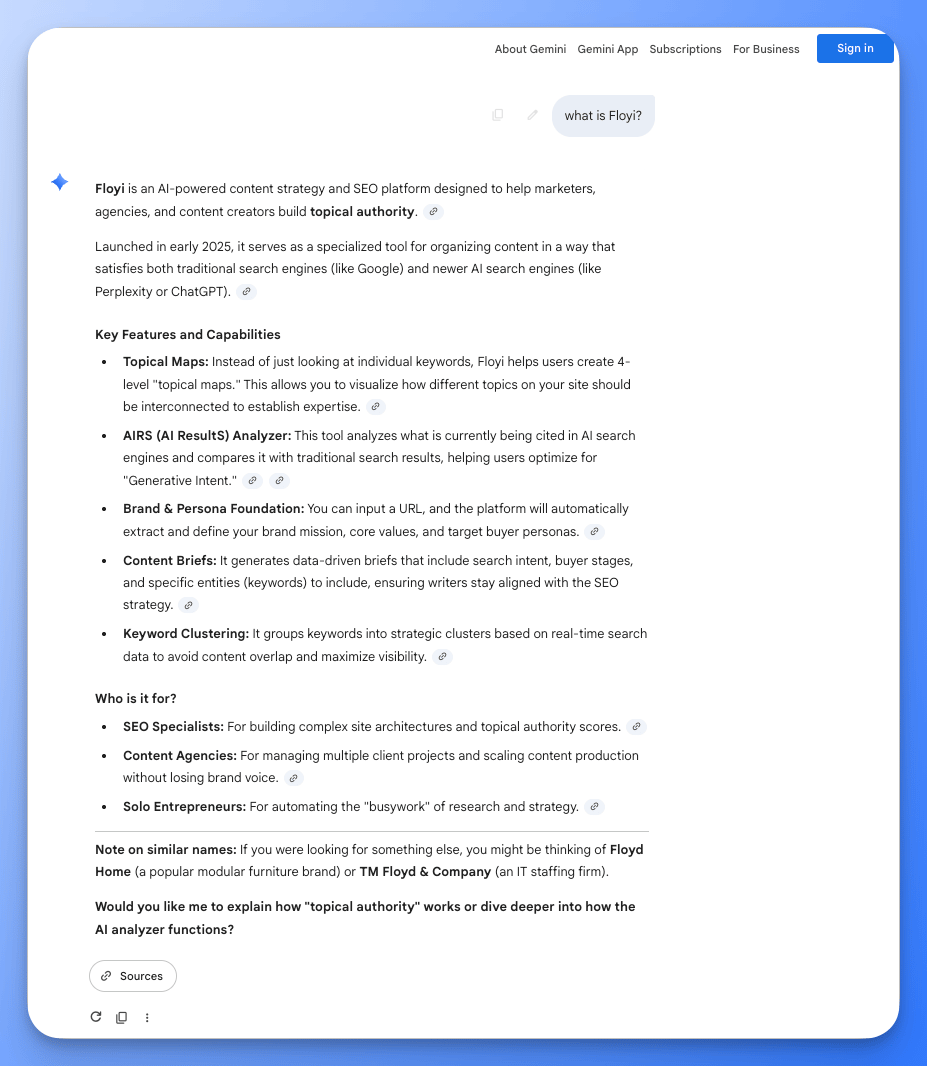
source: Logged-out Gemini result (gemini.google.com)
That is the playbook right there. You do not “game” Gemini. You reduce guesswork. You make it easy for Gemini to label what you are, who you are for and when to recommend you
I can’t prove which inputs caused the suggestion, but these moves likely improved our odds:
Repeat one category sentence everywhere. Keep the same wording on your homepage, feature pages, release notes and press releases.
Name the job in buyer language. Use phrases people ask for, like topical map builder, sitemap planning, internal linking and content brief generator.
State “who it’s for” without hedging. Roles first. Outcomes second. Simple words.
Publish crawlable “what it does” pages. Do not hide the basics behind a login.
Add schema that matches your category. SoftwareApplication, Organization, Product and FAQ where it fits.
Earn third-party descriptions. Reviews, comparisons and community threads beat self-claims.
Reduce brand ambiguity. Handle similar-name confusion and keep your naming consistent across the web.
Write literal copy. Cut buzzwords, cut metaphors, keep it quotable.
None of this guarantees recommendation. It just makes it easier for Gemini to recommend you without guessing.
As you take stock of this year’s work and decide what matters next year, focus on the boring stuff: consistent language, crawlable pages and outside validation.
AD
Introducing the first AI-native CRM

Connect your email, and you’ll instantly get a CRM with enriched customer insights and a platform that grows with your business.
With AI at the core, Attio lets you:
Prospect and route leads with research agents
Get real-time insights during customer calls
Build powerful automations for your complex workflows
Join industry leaders like Granola, Taskrabbit, Flatfile and more.
SEO + GEO
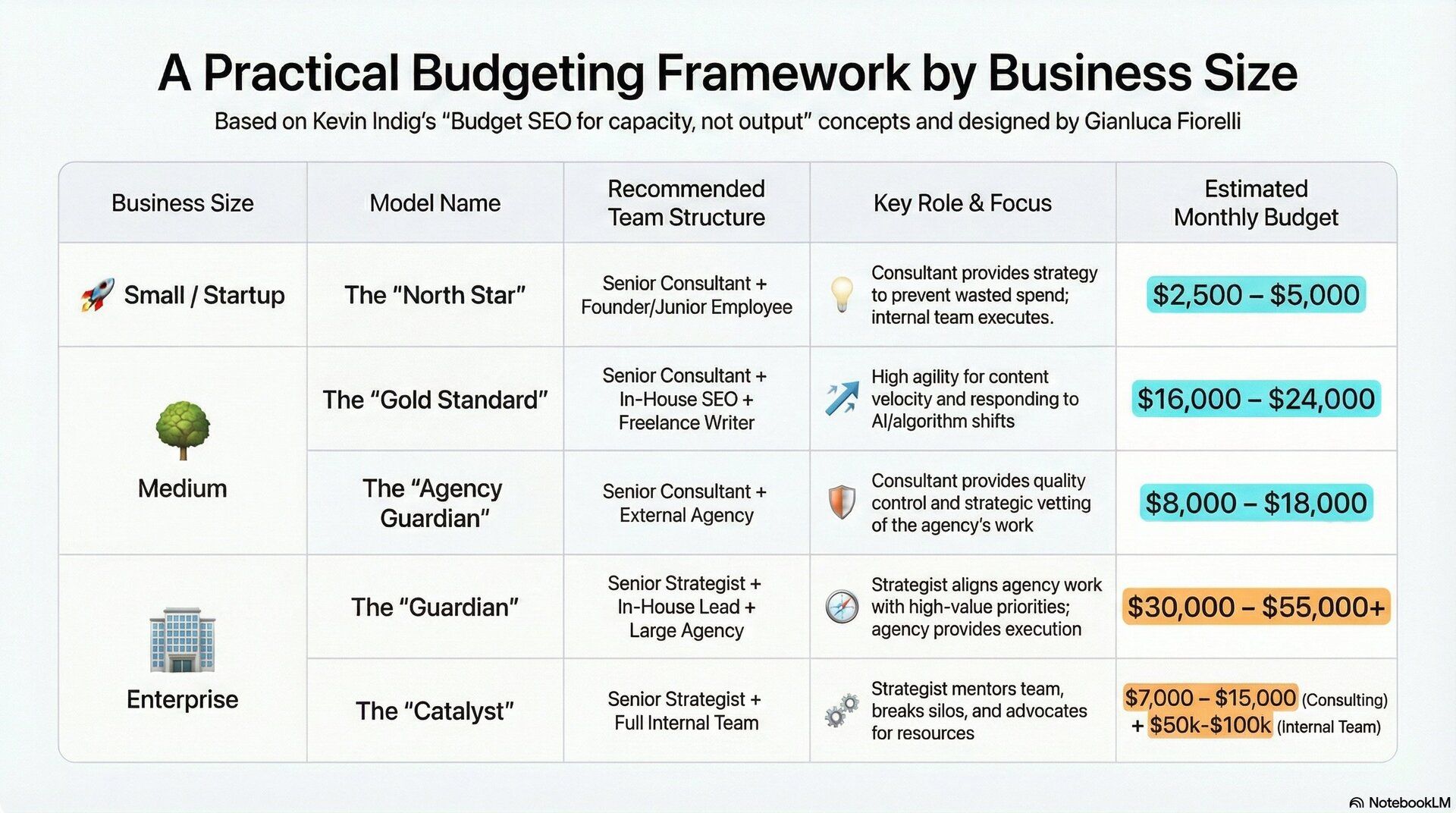
Gianluca Fiorelli says SEO budgeting should buy capacity, not a fixed bundle of “5 articles and 10 links.” Using Kevin Indig’s framing, capacity means strategic brainpower and the ability to pivot across classic search, AI answers and other discovery surfaces. He lists seven priority investments: digital PR, technical SEO and UX, audience and first party research, ongoing content re-optimizations, additive content with information gain, engineering and design support, and video plus custom graphics. Then he translates that into staffing options and budget ranges for startups, mid-market and enterprise teams, plus the math behind those estimates.
Mateusz Makosiewicz argues that “freshness” is a ranking and AI citation lever you can control, if you treat updates like product work, not cosmetics. Start by finding stale pages at scale: crawl your site and filter for old article or posts never updated. Prioritize pages with existing authority and traffic, then refresh what users and bots notice: replace dated stats, prices and screenshots, add what competitors cover, and time seasonal updates a few months early. Signal the work by updating schema dateModified, adding a “Last updated” line and strengthening internal links.
Myriam Jessier argues that image SEO is now about machine readability as much as load speed. Start with performance basics, then make pixels legible: use high resolution, avoid heavy compression, boost contrast, and shoot packaging text large enough for OCR. Treat alt text like grounding, describing what’s actually visible so models resolve ambiguity. Favor original photos because duplicate detection can credit the first source. Audit object co-occurrence with Vision APIs to ensure props reinforce your brand story. And check facial sentiment signals and lighting so AI reads the right emotion for the query intent. It’s a way to stay discoverable.
Barry Schwartz reports that Google is sending far less web search traffic to news publishers, dropping from 51% in 2023 to 27% today, based on NewzDash research across 400 outlets. The gap is being filled by Google Discover, now delivering about two thirds of Google sourced visits, which is powerful but volatile. If you run a content site, treat this as a diversification alarm. Audit where your sessions really come from, build repeatable Discover friendly formats, and shore up owned channels like email, apps, and memberships. Measure weekly so a platform swing does not blindside revenue for you and team.
Dan Petrovic breaks down new data showing exactly how much of your content Google’s Gemini systems actually use when generating AI answers. Analyzing thousands of queries, he finds that Google works with a fixed grounding budget of roughly 2,000 words per query, split across sources by relevance. The top-ranked page can receive twice the grounding of lower-ranked sources, while longer pages do not gain more exposure. Most pages contribute only a few hundred words, no matter how long they are. This shows relevance, structure and density matter more than sheer length if you want AI visibility.
Jason Packer walks through a clean, controlled experiment that answers a question many SEOs have danced around: how does ChatGPT know about brand new sites that only Google has indexed? By creating a fake company, submitting it only to Google Search Console, and watching what ChatGPT could and could not return, Jason shows that ChatGPT’s knowledge matched Google SERP snippets exactly, truncations and all. The takeaway is clear. If your page is not visible, well summarized, and cleanly indexed in Google, ChatGPT will inherit those same limits. Snippets, indexing hygiene, and crawl paths now matter beyond rankings.
AI
Chris Morris reports OpenAI is edging toward ads in ChatGPT, but is pausing to sharpen the product as Google’s Gemini heats up. A beta Android build reportedly contains ad-related code, suggesting sponsored answers or new conversation-native ad formats could arrive once reliability and personalization improve. For marketers, start mapping where paid placements could influence discovery: test prompt-based shopping queries, tighten brand and product facts across your site, and keep structured data, images, and reviews clean so AI can cite you confidently.
Yulia Deda ran 100,000 prompts and checked 145,463 cited URLs to see how often ChatGPT sends people to dead pages. Good news: 97.55% load. Bad news: 1.22% return 404s, about double Google AI Overviews at 0.56%, and worse than AI Mode and organic results. ChatGPT also cites far fewer redirects, so when it is right you land fast, but when it is wrong you hit a wall. Her fix is pure housekeeping: audit 404s, clean up redirects, keep URLs consistent and track how AI tools cite your pages. Set Search Console alerts to catch phantom URLs before they collect backlinks.
Barry Schwartz reports that ChatGPT has started showing local knowledge panels when you ask for local info and click a business name, opening a sidebar panel with details and photos. Test your own listings and verify the address, imagery, and links, since Barry saw an outdated office photo and location for his company. Greg Sterling notes it does not trigger automatically for branded queries, so click behavior matters for visibility. Brad Brewer claims it mirrors your Google Business Profile and updates fast, so keep your GBP URL and core fields current and consistent.
AI Ripples
OpenAI explains how prompt injection targets browser agents by planting hostile instructions in everyday content, like emails, docs and webpages, then tricking the agent into doing the attacker’s job. For teams building agent workflows, they advise avoid overly broad prompts, limit logged-in access when possible, and scrutinize confirmations for sensitive actions.
MARKETING
Michel van Luijtelaar digs into 60,000 Google Business Profiles and finds review removals surging worldwide in 2025, with both one star and five star posts disappearing. Restaurants and retail see the most churn, while medical and home services skew toward five star deletions. Timing matters too: some categories lose reviews within six months, others get retroactive purges years later. Geography adds a twist, with Germany shaped by defamation takedowns. So monitor reviews like analytics, keep your own archive, respond fast, and use tracking tools so sudden drops do not blindside your local SEO performance this quarter.
Matt G. Southern digs into a 300,000-video dataset and finds the thumbnail face rule is mostly myth. On average, videos with faces perform about the same as those without, but the real story is segmentation. Bigger channels see a modest lift from faces, some niches gain while others lose, and multiple faces beat a lone reaction shot. The smart move is to test, not guess: use YouTube Studio’s Thumbnail Test and Compare, judge winners by watch time, and make sure the thumbnail promise matches the first 30 seconds so clicks do not crater retention. Try three variants and keep winners.
TOOLS AND RESOURCES
James Winn breaks down why big brands keep WordPress as the content engine but swap the front end for modern frameworks like React or Next.js. The pattern across TechCrunch, Nike, Spotify and others is consistent: editors keep a familiar CMS, while teams gain faster performance, stronger Core Web Vitals, better security and easier omnichannel publishing. He says to go headless when you need speed at scale, multiple platforms consuming the same content, or serious design flexibility, and stick with traditional WordPress if you do not have the dev resources to run a more complex stack.
My Take: I never explored headless WP much, but I have started building sites in Astro and Antigravity (‘Cursor’ from Google). I can just tell Antigravity what to do and it’ll do everything for me. I haven’t built sites this fast in a long time, since before WP got so bloated. After the initial setup, by Antigravity of course, publishing posts is super quick. Here’s my process:
Create an article on Floyi
Create a new blank .md file in Antigravity
Copy the markdown in Floyi and Paste in .md file
Tell Antigravity to create the schema
Push the updates to Github and that automatically updates the site
Sites are hosted on Vercel and Cloudflare Pages - both free. Huge advantage is they’re both super fast, because they’re static pages.
The “annoying” part of doing it this way is to have a list of all the things that your SEO plugins do, like Rank Math or Yoast. But you only need to do that once because you can tell Antigravity to create automated solutions for all of them.
If you want to see an Astro-built site, check out floyi.com.
BUSINESS IDEAS
Philip Ghezelbash explains how to boost a SaaS exit price in just 90 days by tightening what buyers pay for: predictable profit. Start by cutting churn with cancellation data, exit surveys, and proactive onboarding. Raise prices based on value, grandfather current users, and push annual plans with a clear discount to lock in cash flow. Audit expenses, trim unused tools, and improve margins. Reduce customer concentration by growing smaller accounts and diversifying traffic beyond ads. Document SOPs, automate support and billing, and clean up dashboards so numbers are easy to trust. Then package it all into a simple growth roadmap.
WAYS WE CAN WORK TOGETHER
Floyi - The only AI-powered tool that builds 4-level topical maps. Don’t just plan your content strategy - make it unstoppable.
TopicalMap.com Service - Let us do the heavy lifting. We handle the research, structure, and strategy. You get a custom topical map designed to boost authority and dominate your niche and industry.
Topical Maps Unlocked 2.0 - Unlock the blueprint to ranking success. Master the art of structuring content that search engines (and your audience) love - and watch your rankings soar.
AD
Shoppers are adding to cart for the holidays

Over the next year, Roku predicts that 100% of the streaming audience will see ads. For growth marketers in 2026, CTV will remain an important “safe space” as AI creates widespread disruption in the search and social channels. Plus, easier access to self-serve CTV ad buying tools and targeting options will lead to a surge in locally-targeted streaming campaigns.
Read our guide to find out why growth marketers should make sure CTV is part of their 2026 media mix.
What Did You Think of This Week's Wave? |
LIKE DIGITAL SURFER?
Find me and others in the Digital Surfer Discord community.
I’d also love to know what you think and if you have any ideas for the newsletter. Reply or email me at [email protected].
I’d also appreciate it if you shared it with fellow digital surfers.
You currently have 0 referrals, only 3 away from receiving LinkedIn Shout-out.
Have a great week taking your SEO and digital marketing to another level!
And don’t forget to drag the Digital Surfer emails to your Primary Inbox 🌊
Reply