- Digital Surfer
- Posts
- Your Headline is Fine. Google Just Rewrote It.
Your Headline is Fine. Google Just Rewrote It.
AI-Generated Content Performance; ChatGPT Checkout Fails Walmart; Vibe Designing; Claude's OpenClaw Killer; AI Crawlers Won't Be Denied; and Much More!

Yoyao
March 21, 2026 • Est. Learning Time: 12 minutes
In partnership with

Quick note.
I'm launching Floyi on Product Hunt this Tuesday.
It's the topical authority platform I've been building for the past year. Connects strategy, content, and measurement in one workflow.
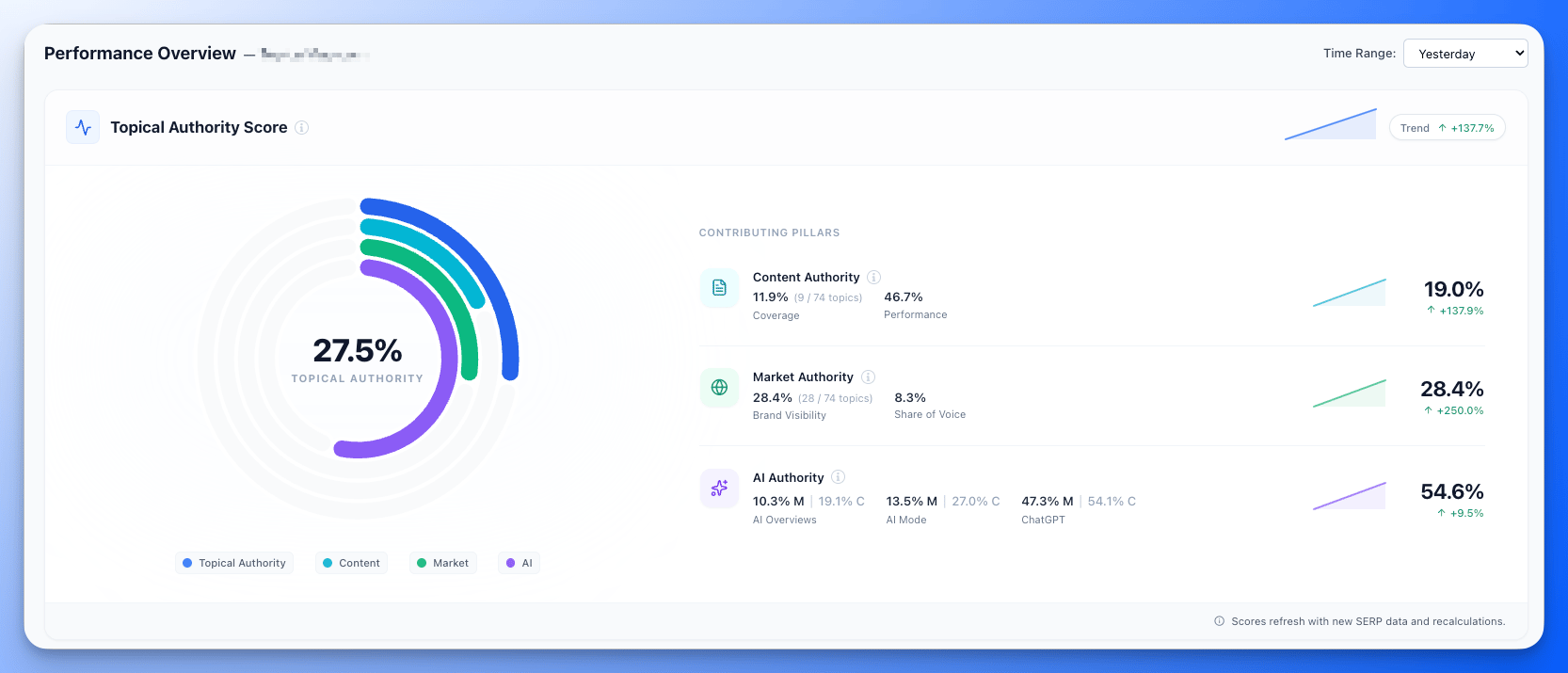
Floyi’s Topical Authority Scoring
There’s also going to be a special Product Hunt offer, so if you’ve been wanting to try Floyi - don’t miss out.

March Madness is here!
AD
Speak your prompts. Get better outputs.

The best AI outputs come from detailed prompts. But typing long, context-rich prompts is slow - so most people don't bother.
Wispr Flow turns your voice into clean, ready-to-paste text. Speak naturally into ChatGPT, Claude, Cursor, or any AI tool and get polished output without editing. Describe edge cases, explain context, walk through your thinking - all at the speed you talk.
Millions of people use Flow to give AI tools 10x more context in half the time. 89% of messages sent with zero edits.
Works system-wide on Mac, Windows, iPhone, and now Android (free and unlimited on Android during launch).
SEO + GEO
Kyle Roof ran a controlled test across multiple domain pairs and TLD extensions to see whether shorter URLs or shorter top-level domains provide any ranking advantage over longer alternatives. The study found some early visibility signals for short domains and short TLDs, but the dataset is limited and the pattern is not definitive. The study tracked rankings across three dates between November 2025 and January 2026, with mixed results across six domain pairs. Kyle says content quality, on-page SEO and technical setup remain the primary ranking drivers regardless of URL or TLD length.
Yevheniia Khromova shares results from a two-part experiment where SE Ranking tested AI-generated content on both an established domain and 20 brand-new sites. The key insight is that human-edited AI content on the SE Ranking blog continues to rank and attract traffic, while fully AI-generated content on new domains collapsed after about three months.
Six AI-assisted articles on the SE Ranking blog received 555K impressions and 2,300+ clicks between June 2024 and July 2025.
3 of the 6 AI-assisted articles rank in the organic top 10, with two reaching position 1.
5 of the 6 AI-assisted articles trigger AI Overviews, and four appear as cited sources.
SE Ranking published 2,000 fully AI-generated articles across 20 new domains in November 2024.
70.95% of the new AI-generated pages were indexed within the first 36 days.
Eight sites started ranking for 1,000+ keywords within one month, generating 122K impressions and 244 clicks.
Starting February 3, 2025, all 20 sites lost search visibility entirely, with no pages in the top 100.
The study concludes that fully AI-generated content may produce short-term gains but is not sustainable without human editing and optimization.
My Take: This is one of the cleanest head-to-head tests of AI content with and without human intervention. The message is simple: AI can help you move faster, but if you skip the editorial layer, the gains disappear. The platforms that survive will be the ones that treat AI as a drafting tool, not a publishing pipeline.
Danny Goodwin reports that Walmart tested OpenAI's Instant Checkout with 200,000 products and found that purchases completed inside ChatGPT converted at roughly one-third the rate of transactions where users clicked through to Walmart.com. Daniel Danker, Walmart's EVP of product and design, described the in-chat checkout experience as "unsatisfying," and the company is already pulling back. OpenAI has begun phasing out Instant Checkout in favor of merchant-controlled experiences, and Walmart plans to embed its own chatbot, Sparky, inside ChatGPT so users can log into their accounts and complete purchases within Walmart's system instead.
My Take: This is an early data point, but it confirms that discovery and conversion are still two different problems. Brands may gain visibility through AI interfaces, but the final purchase still happens where the experience is trusted and familiar.
Lazarina Stoy analyzed how AI search platforms personalize fan-out queries using memory and context, comparing Perplexity, ChatGPT, Claude, Gemini and Copilot. She explains that personalization in AI search moves upstream to query generation rather than just downstream ranking, which means the questions AI systems ask are already shaped by user context before any results surface. She notes that platforms differ in how aggressively they inject personal data into query expansion, with some pulling full conversation history and others relying more on the immediate prompt.
My Take: This is good, but also lengthy, so grab that coffee refill ☕️
Vince Nero analyzed 4 million citations from 3,600 prompts across ChatGPT, Gemini, AI Overviews and AI Mode to see whether blocking AI crawlers reduces citation exposure. The data suggests that robots.txt directives do not reliably stop AI systems from citing publisher content, with the majority of blocked sites still appearing in AI results.
70% of sites blocking ChatGPT-User still appeared in AI citations.
82% of sites blocking OAI-SearchBot still appeared in citations.
88% of sites blocking GPTBot still appeared in citations.
92% of sites blocking Google-Extended still appeared in citations.
About 95% of citations in the dataset came from sites that block training bots.
The study says AI systems may be bypassing robots.txt, using SERP-level data without fetching pages, or accessing content through Common Crawl before blocks were in place.
Vince Nero shares another study and analyzes 4 million citations to see whether AI data partnerships with news publishers lead to more visibility in AI answers. The headline finding is that partnerships do not meaningfully increase citation share, because most citations come from live search and retrieval rather than training data.
Only 2.94% of all news citations came from publishers with confirmed OpenAI or Google data partnerships.
ChatGPT cited OpenAI partner publishers 28.5% of the time, but OpenAI has 17 partners compared to Google's one.
Less than 1% of citations from Gemini, AI Mode and AI Overviews came from Google's partner, the Associated Press.
AP appeared in zero Gemini results despite Google saying the partnership would deliver real-time information to the Gemini app.
The study concludes that partnerships are for training data, while citations come from live retrieval, which explains the disconnect.
James Allen says AI will not replace SEO but will redistribute where human expertise is most valuable. AI can automate routine tasks like generating alt text or writing product descriptions, but it still depends on structured prompts, clean data and technical oversight to produce usable outputs. He also notes that full automation of complex SEO workflows remains difficult because audits pull from too many disconnected sources, and current AI tools struggle to retain context across long data sets without human correction.
My Take: The job is not disappearing but it is becoming more about system design and less about task execution. SEOs who can translate technical knowledge into structured AI workflows will keep their edge. Those who rely on manual work alone will get squeezed.
Danny Goodwin reports that Google is testing AI-generated headline rewrites in traditional Search results, not just Discover. Google told The Verge the experiment is small and narrow, but the goal is to match titles more closely to queries and improve engagement. One example showed Google shortening a long Verge headline to a stripped-down phrase, which raises concerns about changes to meaning, brand voice and click-through rates. Google already rewrites title links automatically, but this test would expand that capability using generative AI.
My Take: This is another reminder that publishers do not control how their work appears in Search. Google has been rewriting titles for years, but generative AI makes the edits more aggressive and harder to predict. If headlines start shifting based on query context, then CRO becomes almost impossible to measure at the SERP level.
Donna Rougeau says SEOs should stop trying to be futurists and start being archaeologists, because the engineering blueprints for today's AI search features were filed in patent offices 10 to 15 years ago. Agent rank, filed in 2007, describes digital signatures connecting content to authors and assigning reputation scores, which is what Google now calls E-E-A-T. The fact repository patent from 2006 predates the Knowledge Graph and powers the answer engines we see today. The article also distinguishes between AEO, which needs confidence anchors for direct answers, and GEO, which needs information gain for synthesis responses.
Dayna Lucio says multi-location brands often create internal competition when each location publishes similar blog content targeting the same keywords. The fix is to clarify roles: corporate should own educational resources, core service pages and brand-level content that builds authority at scale, while local teams should focus on geo-specific content like location landing pages, local FAQs and market-specific testimonials. Without that governance, brands risk keyword cannibalization, diluted link equity and crawl inefficiency across hundreds of low-value URLs.
Jeff Oxford analyzed 20.9 million shopping keywords using Ahrefs' database and found that AI Overviews now appear on 14% of product searches, up from 2.1% in November 2025. The 5.6x increase in four months signals that ecommerce sites are no longer immune to the click erosion that content publishers have been tracking for over a year.
Greg Finn reports that Google's response to the UK's Competition and Markets Authority reveals the company is working on new controls that would let website owners opt out of having their content used in generative AI features like AI Overviews and AI Mode. Google said its goal is to make sure website owners have the right controls to manage how their content is used, though it did not provide a timeline for when these controls might launch.
Rich Sanger says most local service sites are built around service names, but customers often start with problems. Jobs-to-be-done pages fill that gap by guiding readers from symptoms to causes to options to cost context, then drawing a clear line for when to call a pro. The structure converts because it mirrors how people actually think when they are deciding whether to hire someone or try to fix it themselves.
Chartbeat data shows search referral traffic to small publishers dropped 60% over two years, nearly three times the decline at large publishers. ChatGPT referrals grew more than 200% during that window, but chatbots still account for less than 1% of all publisher page view referrals.
Small publishers (1,000-10,000 daily page views) lost 60% of search traffic.
Mid-sized publishers (10,000-100,000 daily page views) lost 47%.
Large publishers (over 100,000 daily page views) lost 22%.
Page views from Google Search fell 34% between December 2024 and December 2025.
Google Discover referrals fell 15% over the same period.
SISTRIX analyzed more than 100 million keywords in Germany and found that AI Overviews now appear on roughly 20% of search results. When an AIO is present, CTR at position 1 drops from 27% to 11%, and the total organic click rate falls from 57% to 33%.
Benu Aggarwal says the webpage is no longer the unit of digital visibility because AI systems now operate on structured ecosystems of entities. She introduces the comprehension budget concept, which means AI systems burn expensive GPU cycles resolving ambiguous brands and relationships. Deep Schema.org markup in a content knowledge graph can improve LLM response accuracy by up to 300% and lift traffic by 20-40%, but only if the schema includes consistent identifiers, external sameAs links, and callable actions like BuyAction and ReserveAction for the agentic web.
SEO + GEO Ripples
AI Overviews are appearing more often for breaking news queries, according to Glenn Gabe, who noticed Top Stories modules getting pushed down when AIOs show up. Google previously said AIOs were "purposefully not triggered for hard news queries," but the pattern suggests that stance may be shifting. News publishers should track AIO visibility for major story categories to see whether the SERP layout is changing in ways that affect click paths.
Perplexity's new Comet browser for iOS defaults to Google Search for navigation, local and transactional queries, according to CEO Aravind Srinivas. He says Google still does a better job for those use cases, while Perplexity handles informational queries through its AI answer engine.
Google's John Mueller says 404 crawling is a positive signal, according to Roger Montti. Mueller explained that repeated crawling of 404 pages means Google would be okay with picking up more content from your site, not that something is broken. Switching to 410 response codes will not stop the crawling, so the best approach is to just let them be.
Google retired multiple legacy ad format policies on March 17th, including requirements for form ads, image quality, responsive ads and text ads. Anu Adegbola reports that the old formats have transitioned into newer campaign types, making the legacy policy frameworks obsolete. Advertisers should now rely on current Google Ads policies for automated and AI-driven campaigns.
John Mueller says moving to HTTPS is like a site migration, because all URLs need to be recognized, recrawled and reprocessed individually. He responded to a Reddit user who lost top 3 rankings after switching to HTTPS, advising patience and warning against using the URL removal tool, which would hide both HTTP and HTTPS versions from search results.
Google removed "What People Suggest," the AI feature that crowdsourced health perspectives from online discussions, calling it part of a broader simplification of the search results page.
AI
Google is evolving Stitch into an AI-native software design canvas that lets anyone create high-fidelity UI from natural language. The new "vibe design" approach lets users explain business objectives, user feelings, or inspiration rather than starting with wireframes, while the redesigned UI adds an infinite canvas, a design agent that reasons across project evolution, and an Agent Manager for working on multiple ideas in parallel. Stitch also introduces DESIGN.md for sharing design rules across tools, instant interactive prototypes, voice capabilities for real-time design critiques, and an MCP server for integration with developer workflows.

Google is expanding Personal Intelligence across AI Mode in Search, the Gemini app, and Gemini in Chrome for U.S. users. The feature connects apps like Gmail and Google Photos to give tailored responses, such as shopping recommendations based on past purchases or travel itineraries built from hotel confirmations and travel history. Users control which apps connect and can toggle connections on or off at any time. Google says Gemini and AI Mode do not train directly on Gmail inboxes or Google Photos libraries, only on specific prompts and model responses.
Carl Franzen reports that Anthropic launched Claude Code Channels, a new feature that lets developers message Claude Code directly from Telegram and Discord to assign coding tasks and receive notifications when work is complete. Early reactions on X have been definitive, with multiple observers calling the feature an "OpenClaw killer" that eliminates the need for dedicated hardware to run persistent AI agents.
AI Ripples
OpenAI released GPT-5.4 mini and nano, smaller faster versions of its flagship model optimized for coding, tool use, multimodal reasoning and high-volume API workloads. GPT-5.4 Mini runs more than 2x faster than GPT-5 Mini and Nano is the smallest cheapest option. Nano pricing is $0.20 per 1M input tokens / $1.25 output. Mini is $0.75 input / $4.50 output (>2x GPT-5 Mini).
Cursor launched Composer 2, a new in-house coding model that beats Claude Opus 4.6 but still trails GPT-5.4 on Terminal-Bench 2.0. The model is tuned for long-horizon agentic coding with a 200,000-token context window, and pricing dropped 86% compared to Composer 1.5 at $0.50 per 1M input tokens for the standard tier.
Perplexity launched Perplexity Health, a suite of data connectors that pulls together electronic health records, wearable data and lab results to personalize health answers. It connects to Apple Health on iOS and uses b.well Connected Health for EHR access, making Perplexity the second major AI platform after OpenAI to integrate with Apple Health.
MARKETING
Maggie Humphrey reports that a DTC retailer with a 2.2-day average conversion window switched from 30-day to 7-day click attribution. The results showed cost down 6.3%, conversions up 42.9%, conversion value up 52.1%, and ROAS up 62.3%. Marketing mix modeling data revealed Google's incremental ROAS increased 10% to 1.82, while Meta's dropped 25% to 0.59. The shorter window improved signal quality for Smart Bidding and clarified cross-channel contribution.
CONTENT
Ryan Law says the gap between human-written and AI-generated content has effectively closed for most SEO use cases. He uses Claude Code, Ahrefs MCP and roughly 15 custom SKILLs to build content that includes his personal experience, matches his editorial voice and performs as well as anything he would write manually. The shift is not that AI has become creative, but that writing itself is more mechanical than people want to admit, and modern tooling lets skilled operators chain prompts, data sources and review steps into a reliable production system.
My Take: Compare to 👇️
Pedro Dias says content scaling strategies keep failing because teams treat content as a manufacturing problem rather than a craft problem. Content spinning died with Panda, programmatic SEO mostly produced doorway pages, and AI-generated content at scale is repeating the same mistake with better tools. Google's spam policies explicitly list "using generative AI tools to generate many pages without adding value" as scaled content abuse. The key question is what each page offers that readers cannot already get elsewhere.
My Take: This is the counterpoint to the Ryan Law piece. Yes, AI content can match human quality at the sentence level, but that does not mean you should flood your site with it. The economics only work if you are adding something that did not exist before. Most scaled content strategies fail because they answer the wrong question.
SOCIAL MEDIA
Anu Adegbola reports YouTube is testing a sticky banner overlay that persists after users skip ads. Instead of disappearing entirely, a branded card stays visible within the player until the viewer dismisses it. The format extends advertiser presence beyond the initial skip and could redefine what a skipped ad means for performance metrics. Anthony Higman first spotted the test and shared it on LinkedIn.

Danny Goodwin reports LinkedIn replaced several separate discovery systems with a unified LLM-powered retrieval model. The new system generates embeddings that understand what posts are about and how they connect to professional interests, even when posts use different terminology. The ranking layer now uses a transformer-based sequential model that analyzes patterns across past interactions. LinkedIn also said it is cracking down on automated engagement, engagement bait and generic posts, while helping new members personalize feeds faster with an Interest Picker.
Social Ripples
Digg laid off staff and pulled its app from the App Store as the rebooted company tries to rebuild after getting overwhelmed by bot spam and fake activity early on. Sarah Perez reports that Kevin Rose is returning to Digg full-time, while the company says the bigger problem is not just one startup's moderation challenge, but a web environment where AI agents and automated accounts can quickly overwhelm trust-based community systems.
WAYS WE CAN WORK TOGETHER
Floyi - Build Topical Authority that wins in Google and AI Search. Don’t just plan your content strategy - make it unstoppable.
TopicalMap.com Service - Let us do the heavy lifting. We handle the research, structure, and strategy. You get a custom topical map designed to boost authority and dominate your niche and industry.
Topical Maps Unlocked 2.0 - Unlock the blueprint to ranking success. Master the art of structuring content that search engines (and your audience) love - and watch your rankings soar.
AD
Experts Would Invest $100,000 in This Alternative Now
A new report shows 44% of family offices are investing more in residential real estate. Now, you can access these assets with mogul. This platform lets you invest in properties producing +7% yields and 18% IRRs. Plus, they do all the property management for you.
Past performance isn't predictive; illustrative only. Investing risks principal; no securities offer. See important Disclaimers
LIKE DIGITAL SURFER?
Find me and others in the Digital Surfer Discord community.
I’d also love to know what you think and if you have any ideas for the newsletter. Reply or email me at [email protected].
I’d also appreciate it if you shared it with fellow digital surfers.
You currently have 0 referrals, only 3 away from receiving LinkedIn Shout-out.
Have a great week taking your SEO and digital marketing to another level!
And don’t forget to drag the Digital Surfer emails to your Primary Inbox 🌊
Reply