- Digital Surfer
- Posts
- Something Just Moved in GSC
Something Just Moved in GSC
Wave Issue 290; Bing Explains the Index; Google Shows More Links; GEO Metrics to Track; Codex Pets; Anthropic X SpaceX; On-Page AEO; and Much More!

Yoyao
May 09, 2026 • Est. Learning Time: 10 minutes
In partnership with

FIRST …
Something is moving in Google right now.
I just went to Google Search Console and I've been seeing impression upticks across a few sites over the last couple of days.

And as of this writing, nothing has been announced. No confirmed update, no chatter from Google.
Could it be an unannounced update? Could be the early stages of something bigger? I don't have enough data yet to say what it is or what it means.
If you're not already in your GSC, go look at the last few days. See what's moving.

AD

Want content that drives engagement, boosts conversions, and goes viral? Here's how.
minisocial combines micro-influencer activations with high-performing UGC creation. Join top brands like Plant People, immi, Imperfect Foods, and Topicals to see results like:
TikTok ads performing in the top 1% CVR
A 50% drop in cost per add-to-cart
A 92% surge in organic video views
Over a 30% increase in ROAS
With minisocial, it's simple: create your brief in 10 minutes, approve your curated creators, download scroll-stopping content with Whitelisting/Partnership Ad code access baked-in!
SEO + GEO
Bing is shifting part of its index work from ranking pages for humans to grounding answers for AI systems. Traditional search asks which pages a user should visit, while grounding asks which facts can responsibly support an answer, with source attribution, freshness, conflict handling, and abstention when evidence is weak. They frame the new unit of value as groundable information, meaning discrete facts with clear provenance rather than whole documents.
This is one of the clearest descriptions of how SEO is evolving with AI Search. They say optimization from humans to machines are for “fundamentally different outcomes.”
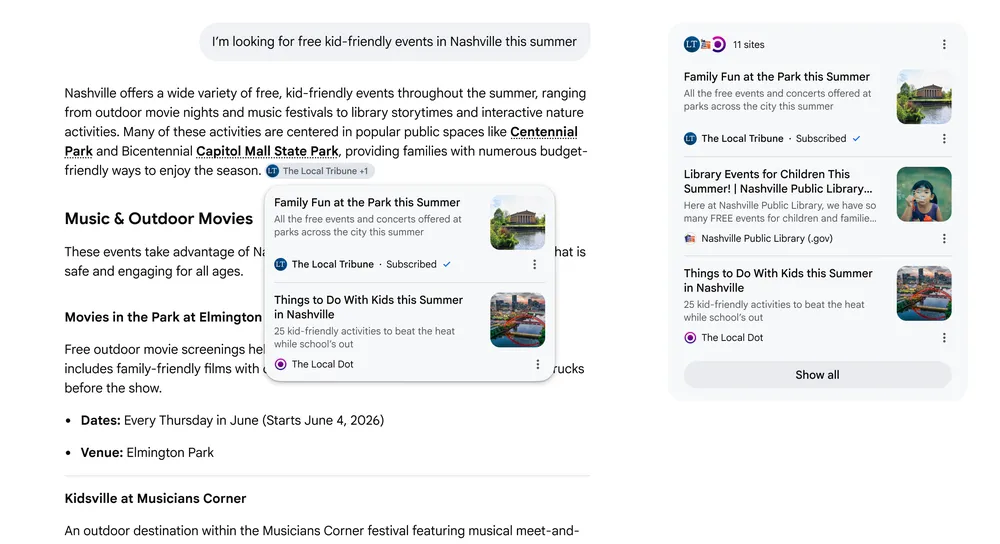
Google is adding more source links, subscription labels, discussion previews, inline citations, and hover previews to AI Mode and AI Overviews. That includes subscription access: Google says AI Mode and AI Overviews will highlight links from a user's news subscriptions, and its Subscription Linking API lets publishers connect paid reader entitlements to Google Accounts.
My Take: These Google Search posts are usually short, but they're useful because they show how Google wants search behavior to move before that change fully shows up in analytics. This is Google showing publishers what the new click path may look like.
Martin Splitt and John Mueller discuss vibe coding websites in Google's Search Off the Record (full transcript). They say AI coding tools can quickly produce static sites, web tools, tests, and deployment workflows, but the output depends on how clearly the operator specifies frameworks, SEO requirements, hosting, validation, and safety checks. Mueller also says "add some SEO" is not a real prompt.
My Take: "add some SEO" 🤣
Jason Tabeling outlines a prompt-level testing method for AI search built around hypothesis, control, and repeatable measurement. His framework uses a simple "if, then, because" structure, then tests one variable at a time across content changes, structured data, and before-and-after prompt sets. He recommends running 5 to 10 target prompts daily for seven days to set a baseline, making one isolated change, then running the same prompts for another seven days to compare inclusion rate and position in response. The method also requires model version notes, timestamped prompt libraries, and a consistent test setup with no login state where possible.
Casey Nifong breaks down eight GEO metrics that move measurement beyond rankings: AI citation frequency, Share of Model Voice, answer inclusion rate, entity recognition, sentiment, prompt coverage, content retrieval success rate, and conversion influence. Her measurement model groups metrics into four working areas: visibility, accuracy and reputation, technical and content readiness, and business impact. GEO reporting should connect prompts, citations, brand framing, retrieval quality, and downstream signals like branded search lift or AI-referred leads.
My Take: Good metrics to cover. Are you tracking anything else?
Sophie Brannon explains why URL structure now matters as a semantic signal for AI retrieval, not just a traditional SEO hygiene item. She says retrieval systems and RAG pipelines may use URLs as plain-text cues for hierarchy, page purpose, topic specificity, and source trust before a page is fully parsed. Her advice is to keep URLs shallow, readable, descriptive, and consistent with the site's taxonomy, such as using /resources/email-marketing/b2b-deliverability-guide instead of date-based or vague paths. She also warns against full URL restructuring for marginal AI gains because migrations still carry link equity and recovery risk.
Greg Jarboe explains that AI search gives PR teams a direct path into SEO visibility because trade press coverage, expert mentions, review profiles, comparison content, and user-generated sources now feed the citation graph. He cites BrightEdge research showing source overlap across AI engines ranges from 16% to 59%, while brand overlap is tighter at 35% to 55%, meaning engines may cite different places but tend to recommend many of the same brands. Stacker found earned media distribution can lift AI citations by a median 239%, while brands with review profiles on Trustpilot, G2, and Capterra are three times more likely to be cited by ChatGPT.
Internet Marketing Gold is running an SEO Hackathon, a free multi-week SEO testing competition where participants form teams, run live experiments, track outcomes, and publish the results. The event runs May 4 to June 25, with team formation through May 24, testing from May 25 to June 22, submissions due June 23, and a live winners event on June 25. Tracks cover AI Search Optimization, On-Page Optimization, and Off-Page Optimization, with test ideas including AI Overview inclusion, citation structure, structured data, trust signals, link quality, and PR signals. Per-track winners receive $2,500, six months of IMG membership, and YouTube feature promotion, while IMG provides testing domains and allows AI tools.
SEO + GEO Ripples
Slow pages may be invisible to AI search systems. Mike King says 499 response codes show when a client disconnects before a server finishes responding, which can keep a page out of ChatGPT and Perplexity citation pools. Profound analyzed 700,000 pages in April 2026 and found pages with failure rates above 75% received roughly 18X fewer citation events, while one iPullRank client saw a 22% AI Search visibility lift after fixing the issue.
Google is ending support for FAQ rich results. Barry Schwartz reports that FAQ rich results stopped appearing in Google Search as of May 7, 2026. Google will drop the FAQ search appearance, rich result report, and Rich Results Test support in June, then remove Search Console API support in August.
Google's UCP checkout is appearing in main search results. Barry Schwartz reports that Universal Commerce Protocol checkout has moved beyond AI Mode and is showing for some free listings, including Wayfair. Clicking Buy can load billing and shipping details so the purchase happens directly from search.
Google faces a lawsuit over an alleged false AI Overview. Matt G. Southern reports that Canadian musician Ashley MacIsaac sued Google after an AI Overview allegedly identified him as a convicted sex offender. The civil claim seeks at least $1.5 million and says the false summary led to a canceled concert and reputational harm.
Ask.com shut down after nearly 30 years. Barry Schwartz reports that Ask.com, formerly Ask Jeeves, closed on May 1, 2026 after launching on June 3, 1996. The shutdown page says IAC discontinued the search business and that "Jeeves' spirit endures." 😢
SEOs are reporting more Google deindexing. Barry Schwartz says some SEOs have noticed higher rates of URL deindexing since early April, though Google's John Mueller said he does not see anything exceptional. The discussion is worth watching because it overlaps with Google's growing selectivity around low-value and stale content.
AI
Chance Townsend reports that OpenAI added Codex Pets, an optional animated companion inside its Codex coding tool. The pet acts as a floating status layer that shows active threads and whether Codex is running, waiting on input, or ready for review. Users can enable it from Settings > Appearance > Pets, then toggle it with /pet, Wake Pet, Tuck Away Pet, Cmd+K on Mac, or Ctrl+K on Windows. OpenAI ships eight built-in pets, including a cat and dog, and lets users prompt Codex to generate custom companions that can be shared online. Read more about pets in the Codex docs.

Anthropic says it has raised Claude Code and API limits after signing a SpaceX compute deal that gives it access to all capacity at the Colossus 1 data center. The deal adds more than 300 megawatts of capacity and over 220,000 NVIDIA GPUs, which Anthropic says will directly improve capacity for Claude Pro and Claude Max subscribers. Yes, SpaceX owns xAI, the rival AI lab behind Grok. Anthropic is also doubling Claude Code's five-hour rate limits for Pro, Max, Team, and seat-based Enterprise plans, removing peak-hour limit reductions for Pro and Max, and raising API rate limits for Claude Opus models.
My Take: My Max plan approves this deal 👍️
OpenAI says it is expanding ChatGPT ads with a beta self-serve Ads Manager, partner buying through agencies and ad tech platforms, CPC bidding, and expanded measurement. US advertisers can register, add payment details, set budgets and bids, upload ads, manage campaigns, and view performance inside the portal. OpenAI says advertiser measurement uses aggregated performance insights and does not give advertisers access to individual conversations.
My Take: I signed up for ChatGPT ads access, so we’ll see if/when I get in.
OpenAI says it is adding three audio models to the API: GPT-Realtime-2 for live voice agents, GPT-Realtime-Translate for live speech translation, and GPT-Realtime-Whisper for streaming transcription. GPT-Realtime-2 adds GPT-5-class reasoning, parallel tool calls, stronger recovery behavior, a 128K context window, and adjustable reasoning effort. The translation model supports more than 70 input languages and 13 output languages, while GPT-Realtime-Whisper transcribes speech as people talk.
My Take: The real-time translation demos are pretty cool.
AI Ripples
Dario Amodei says Anthropic grew 80-fold in the first quarter on an annualized basis. Kate Rooney reports that Amodei told developers the company had planned for 10-fold growth, but demand grew so fast that compute became the bottleneck. His comments came the same day Anthropic announced its SpaceX Colossus 1 capacity deal.
OpenAI expanded Trusted Access for Cyber with GPT-5.5 and GPT-5.5-Cyber. OpenAI says verified defenders can get reduced friction for authorized security workflows like vulnerability triage, malware analysis, detection engineering, and patch validation. GPT-5.5-Cyber is entering limited preview for more specialized authorized workflows tied to critical infrastructure.
OpenAI upgraded ChatGPT's default Instant model. OpenAI says GPT-5.5 Instant produced 52.5% fewer hallucinated claims than GPT-5.3 Instant on high-stakes prompts and reduced inaccurate claims by 37.3% on flagged factual-error conversations. The update is rolling out to all ChatGPT users, with stronger personalization controls and memory sources coming to consumer plans.
Pennsylvania sued Character.AI over a chatbot that allegedly posed as a psychiatrist. Russell Brandom reports that a Character.AI bot called Emilie told a state investigator it was licensed to practice medicine and fabricated a license serial number. The case focuses on medical impersonation, not just general chatbot safety.
OpenAI introduced Trusted Contact in ChatGPT. The optional safety feature lets adults nominate one trusted person who may be notified if automated systems and trained reviewers detect a serious self-harm concern. OpenAI says notifications do not include chat transcripts and are reviewed by humans before being sent.
MIT Technology Review is worth following for the Musk v. OpenAI trial. Michelle Kim reports that week two focused on Musk's motivations, with Greg Brockman saying Musk pushed for a for-profit OpenAI structure and Shivon Zilis testifying that Musk tried to recruit Sam Altman to lead a Tesla AI lab. If you want to keep up with the Musk vs. OpenAI trial, MIT Technology Review has been one of the better places to follow the courtroom details. They don’t write 10+ articles for one day.
MARKETING
Michelle Taite, John Winsor, and Will Fernandez explain that marketing teams are becoming the bottleneck as AI speeds up product development while marketing workflows remain sequential, siloed, and handoff-heavy. Their fix is an agentic marketing organization built around a "brand code," a machine-readable knowledge base for brand strategy, customer insight, product rules, taxonomies, prompt templates, decision trees, and tagged datasets. They point to HubSpot and AWS implementations where marketing materials were adapted up to 98 times faster, unit costs fell by 80%, and click-through rates rose up to 17 times.
My Take: I like the brand code idea because that’s what we do in Floyi 😁 It describes what most AI marketing projects skip: the system needs a source of truth before it can produce useful work at scale. In SEO, this is exactly why topical maps, brand rules, entity definitions, and internal linking logic matter more once agents enter the workflow. If the knowledge base is messy, AI just produces messy work faster. The winning teams will treat marketing ops like product infrastructure, not a pile of prompts.
CONTENT
Ryan Law explains four writing frameworks that make content easier for people and AI systems to parse: BLUF, declarative statements, specificity, and strategic repetition. He builds the advice on research from Kevin Indig and Dan Petrovic, including findings that 44.2% of citations come from the first 30% of content and citation winners are nearly 2X more likely to use definitive language. Ryan also points to entity density as a citation signal, with heavily cited text showing around 20.6% entity density versus 5% to 8% in standard English prose.
Ryan Law separates generative AI from agentic AI with a simple distinction: generative AI creates content when prompted, while agentic AI pursues a goal across multiple steps. He says agentic systems need four layers around the model: planning, tool access, memory, and an action loop that observes, reasons, acts, and checks results. For marketers, the difference shows up in the workflow: a chatbot can draft a section, while an agent can pull keyword data, analyze SERPs, identify content gaps, and produce a research report without handholding. Ryan also notes the risk: agents can take real actions, so teams need approval checkpoints before anything reaches a CMS, customer, inbox, or ad account.
My Take: Both articles actually cover how the Floyi Agents work with Content Brief and Article Draft generation. Agents pulls from the brand identity, buyer personas, topical map, SERP context, internal rules, and content requirements, then turns that into a brief or draft a human can review. They also write in our Floyi framework that’s optimized for AI and algorithms
LINK BUILDING + DIGITAL PR
Vince Nero explains a simple F.I.T. check for building better digital PR media lists: Format, Industry, and Timing. Format means checking recent articles to see whether a journalist writes breaking news, data stories, features, product roundups, opinion, or another story type, not just reading the bio. Industry means narrowing the beat beyond broad labels like technology or health by looking at recent coverage, author pages, and outside profiles. Timing means checking whether the journalist is still active, whether they just covered the same topic, whether local events are dominating coverage, and whether your team has pitched them too recently.
My Take: This is the part of digital PR that separates link building from inbox spam. A good campaign can still fail if the list is lazy.
SOCIAL MEDIA
Reddit released a small business marketing guide. Andrew Hutchinson reports that the 13-page PDF covers product trends, related subreddit communities, and the role Reddit now plays in product research. If you want to see the PDF without filling out your info on the page, reply to this email and I'll send it to you.
YouTube is testing AI music and moderation tools. Andrew Hutchinson reports that YouTube Studio's Replace Song tool will add a Create button that generates four royalty-free instrumental tracks for replacing copyrighted audio. YouTube is also testing comment filters that use conversation context, so creators can find themes like gear questions, part-two requests, excitement, or hurtful remarks.
WAYS WE CAN WORK TOGETHER
Floyi - Build Topical Authority that wins in Google and AI Search. Don’t just plan your content strategy - make it unstoppable.
TopicalMap.com Service - Let us do the heavy lifting. We handle the research, structure, and strategy. You get a custom topical map designed to boost authority and dominate your niche and industry.
Topical Maps Unlocked 2.0 - Unlock the blueprint to ranking success. Master the art of structuring content that search engines (and your audience) love - and watch your rankings soar.
AD
Apple’s Starlink Update Sparks Huge Earning Opportunity

One of the biggest potential winners? Mode Mobile.
Mode’s EarnPhone hit 490M+ users even before global satellite coverage. With SpaceX eliminating "dead zones", Mode's earning technology can now reach billions more, putting them a step closer to potential IPO.
Please read the offering circular and related risks at invest.modemobile.com. This is a paid advertisement for Mode Mobile’s Regulation A+ Offering.
Mode Mobile recently received their ticker reservation with Nasdaq ($MODE), indicating an intent to IPO in the next 24 months. An intent to IPO is no guarantee that an actual IPO will occur.
The Deloitte rankings are based on submitted applications and public company database research, with winners selected based on their fiscal-year revenue growth percentage over a three-year period.
LIKE DIGITAL SURFER?
Find me and others in the Digital Surfer Discord community.
I’d also love to know what you think and if you have any ideas for the newsletter. Reply or email me at [email protected].
I’d also appreciate it if you shared it with fellow digital surfers.
You currently have 0 referrals, only 3 away from receiving LinkedIn Shout-out.
Have a great week taking your SEO and digital marketing to another level!
And don’t forget to drag the Digital Surfer emails to your Primary Inbox 🌊
Reply