- Digital Surfer
- Posts
- Funny thing about Reddit karma...
Funny thing about Reddit karma...
Wave 291; Google's Guide to AI Search; Microsoft Gives You AI Citations Data; Google Widening SEO Playing Field; 54 Publishers Controlled Discover Profiles; and Much More!

Yoyao
May 16, 2026 • Est. Learning Time: 9 minutes
In partnership with

FIRST …
Reddit is everywhere. We all know that.
If you're not building a presence there, you're leaving visibility on the table.
But most important subreddits have minimum karma requirements before you can post. It doesn't matter how much of an expert you are. No karma, no access.
Building karma takes consistency. Consistency takes time. Most of us don't have it.
That's why I built ReplyDeck.
It's a Chrome extension that lets you:
Set up a persona based on your actual expertise
Pick your subreddits and schedule replies automatically
Feed it examples so it learns how you actually sound
Auto-delete downvoted replies so you don't lose karma (coming in v1.0.2, pending Chrome Web Store approval)
I built it for myself. But I figured I wasn't the only one sitting on Reddit expertise with nowhere to post it.
Free plan gives you one persona and up to 10 replies per day. Enough to get started and build karma momentum.
Pro unlocks unlimited personas, unlimited replies, and OpenRouter API access. Your API costs could be zero with free models. Even on a paid model like GPT-5 Mini at 10 posts per day, you're looking at less than 25 cents a month.
Pro is $29. For the first 100 users, it's $10 off. Grab the discount code at replydeck.app before it's gone.
One tip before you start: Don't begin with niche expert subreddits like r/SEO. Karma requirements there are strict and the competition is high. Start on high-traffic general subreddits to build your karma base first. Once you hit the threshold, move into the subreddits that actually matter for your business.

AD
Want to get the most out of ChatGPT?
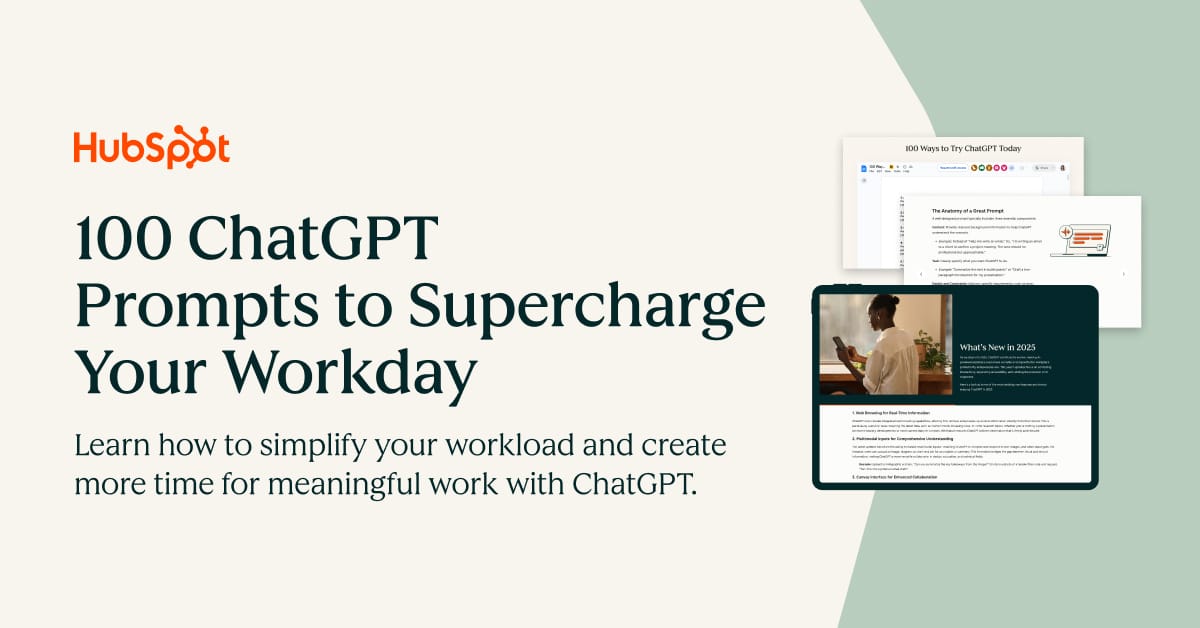
ChatGPT is a superpower if you know how to use it correctly.
Discover how HubSpot's guide to AI can elevate both your productivity and creativity to get more things done.
Learn to automate tasks, enhance decision-making, and foster innovation with the power of AI.
SEO + GEO
Google Search Central explains that optimizing for generative AI features remains rooted in core SEO best practices, emphasizing unique, helpful content and technical soundness over AI-specific hacks. The guide says AI Overviews and AI Mode rely on retrieval-augmented generation and query fan-out, which means visibility still depends on whether Google can crawl, index, understand, and trust the source material.
Create non-commodity content with first-hand experience, original perspective, specific evidence, and useful media instead of generic answers that any model could produce.
Keep technical SEO clean: indexable pages, crawlable content, JavaScript that Google can process, reduced duplication, strong page experience, and clear content structure for humans.
Use Merchant Center, Google Business Profiles, product data, and local business details where relevant so AI responses can pull from reliable entity and commerce information.
Ignore fake GEO shortcuts for Google Search, including llms.txt, AI-only rewrites, artificial mentions, special AI markup, and forced content chunking.
Prepare for agentic experiences by making pages usable for browser agents that inspect rendered pages, DOM structure, screenshots, and accessibility trees.
My Take: This aligns with what we see in practice. The main thing is that it’s just in print now. They also don’t want to call anything AEO or GEO. It’s just SEO. Bing is the opposite, using both AEO and GEO 😅
Microsoft Clarity's AI Citations dashboard is now generally available, giving site owners a way to see when their pages are referenced in AI-generated answers. The dashboard tracks page citations, share of authority against other cited domains, AI referral traffic, grounding queries, cited URLs, and trendlines for cited pages and queries. Microsoft also says topic insights are coming next, grouping cited queries into intent-driven themes so teams can see why AI systems select specific content.
My Take: Clarity’s Share of Authority metric lines up almost exactly with Floyi’s AI Authority score for the Floyi brand and domain - 19.6% vs 19.9%. That is a useful validation point because the two tools measure different surfaces. Clarity tracks Bing Copilot, while Floyi tracks AI Overviews, AI Mode, ChatGPT, and Gemini. If the numbers are this close across separate systems, it suggests we are measuring the right signal. 😁

Mike King explains that cloaking for LLMs makes strategic sense because AI crawlers like GPTBot and ClaudeBot rarely execute JavaScript, allowing sites to protect proprietary data by serving it through client-side rendering while blocking JS files for LLM user agents. He notes that 69% of major AI crawlers can't execute JavaScript at all, and serving content as Markdown instead of HTML reduces token intake by 80%, improving speed and citation eligibility. The approach involves using Cloudflare Workers to detect LLM agents, serve 404 for protected JS files, and provide Markdown versions of HTML pages to AI crawlers while maintaining full functionality for human visitors and traditional search bots.
Philip Elias reports that Google's March 2026 core update made AI Overviews more visible and clicks harder to earn. During the rollout, Raptive saw AIO coverage rise from less than 20% to 26-31% of tracked food impressions, while non-food impressions rose from 24% to 32%. Results with AI Overviews had 30-50% lower click-through rates, but the sites that held up best were not simply the ones with less AIO exposure. They had stronger brand demand, authority, review proof, content depth, freshness, page speed, and ad balance.

Martin Jeffrey explains that Google has historically applied expensive deep-learning ranking layers like RankBrain to a narrow set of roughly 20 to 30 candidate pages, based on federal court testimony from Google's Pandu Nayak. He connects that constraint to Google's newer TurboQuant research, which claims 4x to 4.5x vector compression, near-zero nearest-neighbor search indexing time, and stronger recall. If retrieval economics improve, Google could evaluate a wider pool of pages before final ranking, which would make top-10 competitor analysis less reliable as the main content planning input.
My Take: This is exactly why retrieval-first SEO matters. If the candidate pool expands, the question is not only whether a page can beat the current top results. It is whether the page is clear, self-contained, crawlable, and evidence-rich enough to enter a much larger retrieval set in the first place to find the most relevant. ‘Keywords’ will be even less important.
Sylvain Deaure and Damien Andell analyzed 46,926 publishers and found 54 U.S.-based, English-language publishers with invitation-only enhanced Google Discover profiles. Unlike standard profiles, these claimed profiles let publishers configure banner images, link shelves, pinned posts, social link order, website tabs, and custom About text.
Nearly half the cohort, 27 of 54 publishers, were regional newspapers or local TV stations, suggesting Google is testing the feature heavily with local news.
Forty-one publishers uploaded banners, 33 enabled the links feature, 52 had access to pinned posts, but only 13 were actively using pinned content.
Only 3 of 65 configured links used analytics parameters, leaving most publishers unable to measure whether Discover profile links drive traffic.
The recommended prep: build profile-ready brand assets, decide which five to seven links deserve placement, use dedicated UTM tracking, and define whether profile management sits with a central team or each newsroom.
Frank Olivo explains how SEOs should respond when clients or executives forward AI-generated recommendations. The best response is not to dismiss ChatGPT or defend your expertise. Start by validating the effort, identify which ideas are worth exploring, walk stakeholders through evidence when the output is wrong, and improve the analysis by giving the model better context, competitor data, and evaluation criteria.
My Take: This is now part of SEO client management. People will keep bringing AI-generated audits into the conversation. The operator move is to turn that into a better diagnostic process, not a debate about whether ChatGPT is smart enough to replace expert judgment.
SEO + GEO Ripples
Kevin Indig reports that AI visibility is highly fragmented across ChatGPT, Perplexity, and Google AI Overviews. Omnia data across 3.7 million citations found only 2.35% to 2.45% of cited URLs appeared in all three engines for the same prompt, while 91% appeared in only one. Track presence, portability, and concentration instead of relying on one blended AI visibility score.
Barry Schwartz reports that Google's John Mueller says the Indexing API is inundated by bloggers trying to act like legitimate sites. The reminder: Google's Indexing API is intended for job postings and live stream content, not general blog indexing shortcuts. Whew! It’s good to know companies creating thousands of programmatic pages are not to blame 😅
Google clarified its Search spam policies apply to AI Overviews, AI Mode, and other generative AI responses in Search. Spam tactics designed to manipulate AI-generated answers can now be treated the same way as spam tactics designed to manipulate rankings.
Google AI Mode tests are showing direct hotel booking links inside AI-generated responses. If this test expands, official hotel websites could get a more direct path from AI discovery to booking without relying only on OTA listings.
Google is testing an autocomplete icon that opens an expanded AI Overview. The test uses a magnifying glass with the Gemini logo and turns some autocomplete suggestions into direct entry points for AI-generated answers. Because the current method of showing AI Overview AND blue links are too much. They only want you to read the AI Overview answer.
AI
OpenAI reports that ChatGPT's consumer audience broadened in Q1 2026 across gender, age, geography, and workplace behavior. Users with typically feminine names now represent more than half of users where gender can be inferred, and users over 35 gained message share even though users under 35 still send the most messages overall. The biggest country ranking gains by messages per capita came from the Dominican Republic and Haiti at +9, Japan at +8, Mexico and Tanzania at +6, and Brazil, Costa Rica, Myanmar, and Papua New Guinea at +5.
My Take: This is what mainstream adoption looks like. It is becoming a default layer for research, writing, retrieval, and daily work across broader demographics. For SEO, that means the content strategy problem is not only ranking in Google. It is becoming the source that AI systems can confidently use when people ask for help.
AI Ripples
OpenAI announces a new personal finance experience in ChatGPT for Pro users in the U.S., letting users securely connect financial accounts to get AI-powered insights grounded in their goals and priorities. Do you trust ChatGPT for financial management?
OpenAI is weighing legal options after Apple's ChatGPT integration fell short of expectations. Bloomberg sources said OpenAI expected the Apple deal to drive billions in subscriptions, but the Siri implementation made users explicitly ask for ChatGPT and displayed answers in small windows that were easy to miss. The dispute also complicates Elon Musk's antitrust case against Apple and OpenAI as Apple tests Siri integrations with Claude and Gemini.
Anthropic's $1.5 billion copyright settlement is facing delays after authors objected to the payout structure. A federal judge asked for more detail after class members challenged more than $320 million in requested legal fees, roughly $3,000 expected author payouts, and the lack of stronger restrictions on Anthropic's future use of the works. Authors and copyright holders have filed claims covering more than 92% of the 480,000-plus works in the settlement.
MARKETING
Anu Adegbola reports that Google Ads is adding Gemini-powered dashboards that let advertisers analyze performance through prompts. The new dashboards can generate charts, graphs, and tables in real time, showing metrics like impressions, clicks, video views, cost, and breakdowns by device, audience, and campaign type. Google says more details will come at Google Marketing Live.
Brooke Osmundson reports that Google updated Ads documentation to clarify that search terms from AI Mode, AI Overviews, Lens, and autocomplete may reflect Google's interpretation of user intent instead of the exact query. That means advertisers could see normalized or inferred terms in reporting rather than the literal words a user typed or the full context of an AI-powered interaction. The change matters for negative keywords, compliance reviews, B2B insight mining, ecommerce segmentation, and any workflow that treats search terms as direct customer language.
Anu Adegbola also explains that Microsoft Advertising is bringing LinkedIn profile targeting to connected TV campaigns. Advertisers can target streaming audiences using professional attributes like industry, job function, company category, and professional identity signals. The move extends Microsoft's LinkedIn data advantage into CTV, giving B2B advertisers a way to pair upper-funnel video inventory with more precise professional audience controls.
SOCIAL MEDIA
Elon Musk says the latest X algorithm has been published to GitHub, pointing to xAI's public repository for the “For You” feed recommendation system. The repo describes a May 15 update with an end-to-end inference pipeline, a pre-trained mini Phoenix model, Grox content-understanding components, ad blending, query hydrators, candidate hydrators, and new candidate sources for ads, who to follow, Phoenix MoE, topics, and prompts. Instead of going through the repository yourself, here are a couple of the better summaries:
Andrew Hutchinson reports that TikTok is expanding TikTok Go in the U.S., turning travel discovery into a creator affiliate program. Creators can tag eligible lodging and activity businesses from TikTok's Monetization section, add location and business tags to posts, and earn commissions when users book. TikTok has added integrations with Booking.com, Expedia, Viator, GetYourGuide, Tiqets, and Trip.com, giving travel brands more ways to appear inside videos, search, and location pages.
WAYS WE CAN WORK TOGETHER
Floyi - Build Topical Authority that wins in Google and AI Search. Don’t just plan your content strategy - make it unstoppable.
TopicalMap.com Service - Let us do the heavy lifting. We handle the research, structure, and strategy. You get a custom topical map designed to boost authority and dominate your niche and industry.
Topical Maps Unlocked 2.0 - Unlock the blueprint to ranking success. Master the art of structuring content that search engines (and your audience) love - and watch your rankings soar.
AD
Wispr Flow turns your voice into polished, professional text inside any app. Speak naturally, send confidently. Used by millions, including teams at OpenAI, Vercel, and Clay. Free on Mac, Windows, and iPhone. Try Wispr Flow free.
LIKE DIGITAL SURFER?
Find me and others in the Digital Surfer Discord community.
I’d also love to know what you think and if you have any ideas for the newsletter. Reply or email me at [email protected].
I’d also appreciate it if you shared it with fellow digital surfers.
You currently have 0 referrals, only 3 away from receiving LinkedIn Shout-out.
Have a great week taking your SEO and digital marketing to another level!
And don’t forget to drag the Digital Surfer emails to your Primary Inbox 🌊
Reply