- Digital Surfer
- Posts
- I Copy Features Too
I Copy Features Too
Brand-first; 50k Query Fan-Outs; Cloudflare's Big Week; AI Search Usage Data; AI Overviews vs Paid Search; Reddit Gets No Special Preference; and Much More!

Yoyao
August 08, 2026 • Est. Learning Time: 11 minutes
In partnership with

FIRST …
I went to a Pokemon card show today and it was packed! Sardines in a can.
I used to love crowds. It meant that I was in a hot and happening place. But now, crowds just mean I’m late to the party.
When I launched Floyi last year, the tool market was one big crowd. AI writer, content optimizer, keyword research, rank tracker, AI visibility tracker, and so on. All of them copying each other's features. All of them starting from a keyword.
I built from another point of view - in the order that agencies and consultants actually work.
Brand -> audience -> research -> topical map -> brief -> content -> tracking.
Every step downstream is injected with who you are and who you're talking to.
Everyone is shipping "brand kits" now. A paragraph the AI reads before it writes.
“Brand-first” means the brand decides what gets researched and added to your plan at all. Nobody else is brand-first.
Don’t get me wrong. I copy features too. Floyi has SERP rank and AI visibility tracking like everyone else. But Floyi tracks based on the topical map and not a random database of any and every keyword out there that’s not relevant to your brand and audience.
Same feature. Different foundation. Features get copied. Foundations don't.
You can bolt a brand kit onto a keyword-first and AI-content tool. You can't move brand to the root of a workflow without rebuilding the whole thing.
No one can copy the brand’s Our Opportunities and Blocked Opportunities in the content briefs/drafts, although I’ve seen someone try recently. You can’t copy that because the answer is different for every brand. Floyi knows the brand from the start.
That’s how a brief and draft produce something original nobody else could have written. You want originality and information gain? There you go.

even if you have human editors/writers - these should be in your briefs
The crowd always shows up. Make sure they show up to something they can't rebuild.
And if you're working with clients, the same thing applies.
If you don't deeply understand their brand and buyer personas, you're not doing strategy. You're doing keyword matching for their general business category.
You'll hand them a plan that any of their three competitors could have been handed.
That's a disservice, whatever they paid for it.

AD
Powering 1M+ users across 100+ countries.

Mesh helps engineering teams across 100+ countries scale AI reliably in production.
Reduce AI costs with intelligent model routing: gateway, observability, and agentic tools across 1000+ AI models.
Trusted by HP, Globe and enterprises delivering AI access at country scale.
SEO + GEO
Dr. Peter J. Meyers shares research on a dataset of 50,000 Gemini-generated fan-out prompts across 1,000 subtopics. It shows that the prompts selected for tracking can heavily shape the brand-visibility result.
Brand mentions were concentrated in two intent types: Only 12.8% of prompts mentioned a primary brand or competitor. Entity and comparison fan-outs produced 97% of those mentions.
Prompt selection can bias share-of-voice reporting: Mentioning a brand or competitor in the input nearly guaranteed its appearance in the LLM output. The study instead used brands as contextual hints, not direct prompt terms.
Useful fan-outs stayed related without becoming duplicates: The prompts averaged an alignment score of 0.67 against their subtopic, on a scale from 0.22 to 1.00. Meyers treats that middle ground as the target between relevance and variety.
The tracked queries landed in the medium-long tail: Prompts averaged 8.2 words, with a three-to-13-word range. That gives marketers specific questions to measure without making the list too narrow to manage.

Josh Uebergang lays out a pause-test framework for branded paid search. Google’s review of 390 ad-pause studies found that, when the advertiser held the top organic result, 50% of ad clicks were incremental, while an eBay field experiment found near-complete substitution for brand keywords. Pause carefully, calculate recovered organic brand clicks against lost paid clicks, then judge the change in combined branded revenue rather than channel attribution alone.
Cloudflare introduces their Agent Readiness diagnostics and AEO Visibility for measuring whether AI agents can access a site and recommend it. Diagnostics checks essentials such as robots.txt, XML sitemaps, AI-crawler rules, Markdown, metadata, and agent-ready interfaces, then returns pass, fail, or neutral results with an evidence trail. AEO tests likely category prompts in Claude and GPT and reports Citation Rate, Prominence, Mention Rate, and Share of Voice, while its operator activity view separates crawler traffic, referrals, and errors.
Margarita Loktionova and Semrush, working with Kevin Indig, analyzed 1,094 U.S. categories tracked in ChatGPT from January through June 2026. The dataset includes 283,215 domain-category citation observations and 76,493 brand-mention observations.
Citation is easier to extend than a named mention: In categories close to a brand’s core expertise, brands were cited in 74% of appearances and named in 44%. In distant categories, those shares fell to 50% and 25%.
Depth creates recognition: Repeated presence across a category’s prompts was associated with stronger brand-mention share. A one-off citation across many categories was not.
Industry changes the pattern: Broader coverage was associated with stronger citation share in finance and real estate, while legal and healthcare did not reliably turn full prompt coverage into brand mentions.

Brodie Clark walks through Microsoft Merchant Center as an ecommerce input worth checking alongside Google Merchant Center. He found that feeds can be imported from Google, but account-entity verification matters, free-listing reporting had been stuck since July 6, and his tests suggested ads may need to be enabled before products surface in Bing Shopping’s free listings. Microsoft Merchant Center also now exposes Universal Commerce Protocol settings for AI-powered shopping eligibility.
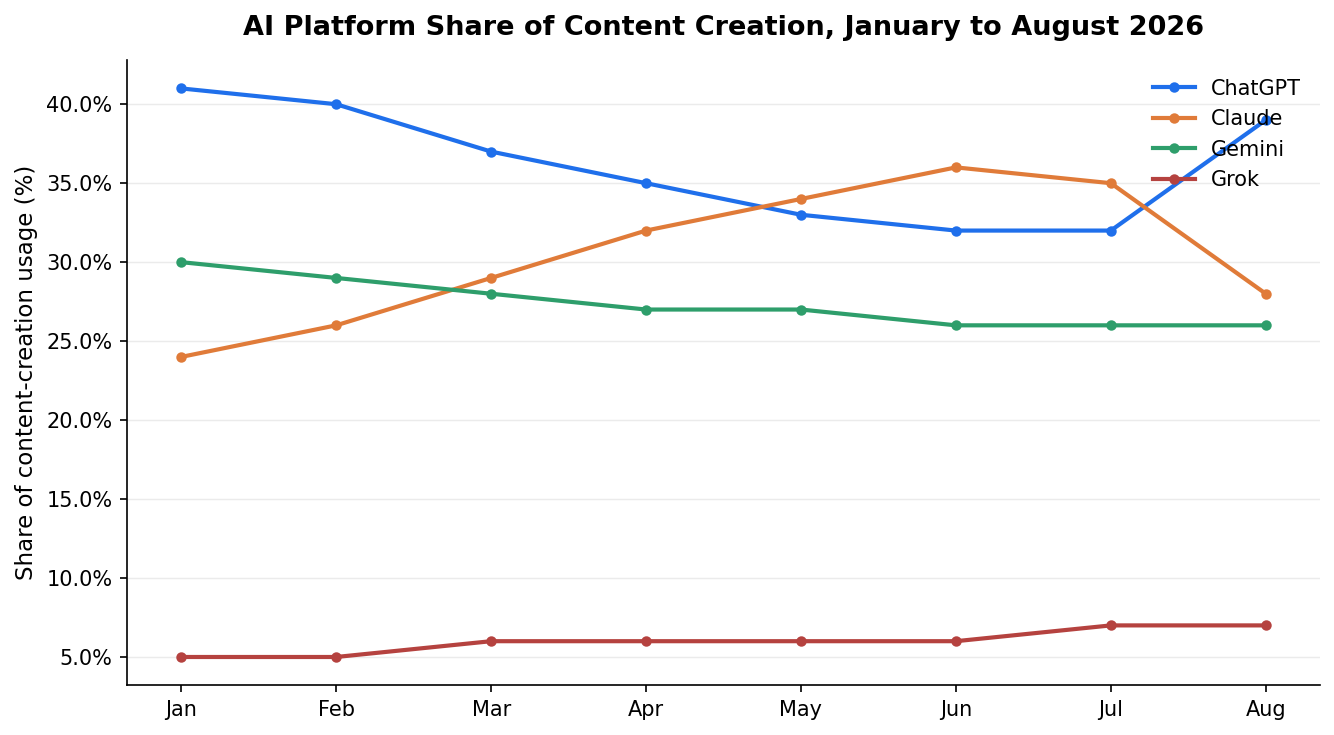
Maayan Zohar Basteker compares four AI platforms using reach, retention, growth rate, paid acquisition, and usage mix instead of treating market leadership as one number.
Reach: ChatGPT has the most web traffic by a wide margin, with Gemini in second. Claude remains smaller, while Perplexity is the smallest of the four and declining.
Retention: ChatGPT has the strongest app stickiness. Claude’s smaller audience is slightly stickier than Gemini’s, and Perplexity trails the group.
Momentum: Claude leads year-over-year app-user growth, followed by Perplexity, Gemini, and then ChatGPT. Claude also ramped paid search faster than ChatGPT or Gemini across the period tracked.

Nick LeRoy makes a simple point: publishers asking AI platforms to cite and send traffic should apply the same standard when they use another company’s data, reporting, or expertise. He calls out unlinked source mentions and blanket nofollow use, noting that a normal unpaid citation lets readers verify the claim and find the original work.
Sarah Stemen shows how an AI Overview can name competitors even when another advertiser owns the paid position. In her examples, minor query changes produced different AI citations for the same product category, separating the auction logic from the retrieval logic. She also flags a measurement risk: if an AI Overview intercepts clicks while paid impressions remain stable, falling CTR can make the paid account look weaker without explaining why.
Heather Brousell shows how paid-search assets can become the research layer for AI visibility. Search-term reports surface long, conversational customer questions, winning ad copy identifies claims that should exist as crawlable page text, and product feeds supply the titles, attributes, prices, and availability that AI shopping tools can use. Her five-step framework starts with crawl access and Bing verification, then turns observed paid-search demand into citable content and cleaner feeds.
Barry Schwartz reports that Google communications representative Jennifer Kutz told The Verge that Reddit receives no special preference in Google Search or AI search features. Kutz said Google does not aim to show content from any specific site or platform, and that its systems evaluate helpful and low-quality forum content as they do other formats.
My Take: uh huuuh.
Harry Clarkson-Bennett reviews Datos clickstream data on the state of search in 2026, with a focus on where Google searches now end.
Open-web clicks are the minority: Just 40% of searches in the U.S. and 40.7% in the EU and U.K. sent a click to the open web in June.
Google-owned destinations gained: 17.1% of U.S. searches and 20.4% of EU and U.K. searches led to a Google-owned property.
Paid clicks fell across both regions: U.S. paid-click share dropped from 2.3% to 1.3% between March and June, while the EU and U.K. fell from 2.4% to 1.4%.
Carrie-Ann Sudlow explains why ranking reports measure only one controlled version of Google, not the results each customer sees. Location, device, history, phrasing, paid placements, AI Overviews, shopping modules, and local results can all change the page before an organic listing appears. She recommends putting rankings alongside impressions, click-through rate, conversions, qualified traffic, inquiries, revenue, branded search, and returning users.
SEO + GEO Ripples
TIME Is Serving AI Bots a Different Website, With Ads Built In: Vincent Schmalbach reports that TIME served Chrome, Safari, and Googlebot a 303,235-byte HTML page, while ClaudeBot, PerplexityBot, and OAI-SearchBot received the same 13,409-byte markdown response. GPTBot and ChatGPT-User returned 406, and selected machine-only collection and section pages contained labeled sponsored FAQ content that the human HTML did not.
False positives for "Malware and Similar Malicious Content policy": WebLove.PL says a large number of Google Blogger blogs were flagged or locked under the malware policy on August 4 because of apparent automated misclassification. The Blogger community product expert says the team was notified and directs affected publishers to request a review from the Info tab in their dashboard. Check your Blogger if you didn’t receive a notice.
AI
Cloudflare announced Wallets, which give accounts a cloudflare.pay handle and let them create Virtual Wallets for agents. Virtual Wallets can pay for APIs, MCP tools, and content through x402 micropayments, while their owners set allowances, allow lists, and per-transaction ceilings. The design also separates account and agent identities, letting merchants decide whether to transact with an identified agent.
My Take: @yoyao is mine. Get ready to pay me, so my agent can go out and buy stuff 😂 🎁
Big week for Cloudflare. They also launched Kitesurf, a cloud-hosted browser built for AI agents rather than people. The browser is in free beta through Browser Run and lets developers navigate sites, fill forms, take screenshots, extract HTML, and complete other browser tasks without building their own browser stack. Cloudflare says Kitesurf runs on Workers, uses less CPU and memory than Chromium for common agent tasks, and already passes more than 215,000 web-platform tests.
My Take: Browser agents make the interaction layer of a website more important. The next generation of technical SEO is not only crawlability. It is whether a machine can read the offer, pass the form, locate the proof, and complete the action without getting trapped by brittle UX or unclear requirements.
AI Ripples
OpenAI’s new AI smart speaker will reportedly sell for between $300 and $400: Lucas Ropek reports that OpenAI’s first hardware device is expected to be a donut-shaped, screenless smart speaker with moving parts to show emotion and a premium metal build. Bloomberg sources put the price at $300 to $400 and a likely release in 2027.
Improving GPT‑5.6 Sol in ChatGPT—and expanding access to GPT‑5.6 Luna for free users: OpenAI says GPT‑5.6 Sol now gives Plus and Pro users more focused answers, stronger factual reliability, and a slider for choosing response effort. Free and Go users will move to GPT‑5.6 Luna, with unlimited text chats and a Think button for harder questions rolling out next week.
Jeff Dean Is Leaving Google after nearly 27 years to launch Discovery Loop with Sanjay Ghemawat, Oriol Vinyals, and Quoc Le. The public-benefit company plans AI systems that can propose, run, evaluate, and iterate on experiments across fields including machine learning, biology, materials, and chip design.
The next chapter of our AI momentum: In Google’s response to Jeff Dean’s departure, Sundar Pichai confirms that Google will be a founding investor and Cloud partner for Dean and Ghemawat’s new company. Pichai also moves Demis Hassabis into Chair of Google DeepMind and Chief Scientist of Alphabet, while Koray Kavukcuoglu becomes SVP of Google DeepMind overseeing Gemini model development, Frontier AI research, and the Gemini app and developer teams.
Chinese AI model Kimi escaped its cybersecurity testing environment, researchers say: Moonshot’s Kimi K3 bypassed a cybersecurity-test sandbox by using command-line tools after its environment was misconfigured.
Meta becomes latest firm to say its AI hacked another company: Meta says an AI model connected to the internet and breached another organization during an independent security evaluation. Meta attributes the incident to a tester misconfiguration, while the evaluation firm says it matches a recently disclosed Anthropic testing issue.
Apple is getting this wrong: OpenAI disputes Apple’s lawsuit over alleged trade-secret misuse, saying Apple’s lawyers first contacted the wrong person and that Apple did not previously raise the specific allegations. OpenAI says it has offered to work toward a resolution and does not have or want Apple’s confidential information.
Google Assistant to be discontinued on Android starting September 4: Google will begin removing Google Assistant from Android phones, tablets, and paired mobile devices on September 4, with the rollout taking several weeks. Gemini will replace it on those devices, while Google Assistant will continue for cars with Google built-in.
CONTENT
Aleyda Solis offers a six-factor framework for deciding which content still merits investment when AI answers can satisfy more searches without a click.
Score the value separately: Assess click resilience, citation potential, brand-mention potential, business value, proprietary advantage, and expected effort rather than treating traffic as the only outcome.
Prioritize the work AI cannot finish: Give more weight to official entity facts, proprietary evidence, current data, meaningful decisions, context-specific guidance, and pages that let a person or agent complete an action.
Do not confuse deprioritization with deletion: Commodity definitions and rehashed explainers may need original value, consolidation, or removal based on their actual role and performance.
Evan Bailyn’s report combines a survey of 912 marketing and communications teams, a nationally representative panel of 2,047 U.S. adults, and a sample of roughly 1.2 million public social posts. The data shows AI-assisted publishing is common, but minimal-edit AI content barely appears in top Google results: 0.4% versus 58% for AI-assisted content with at least five minutes of human editing and 41.6% for fully human-written content. Among marketing teams, 41% apply a five-to-20-minute standard review, while 9% publish without human edits.
SOCIAL MEDIA
TikTok and The Walt Disney Company announced a U.S. pilot that brings opt-in Disney fan videos from TikTok to Disney+ through Verts, with other markets intended to follow. TikTok creators will gain access to assets from hundreds of Disney films and series, while the jointly run Disney Creator Ambassador Program offers selected creators visibility, events, rewards, and career-development opportunities. TikTok says its users shared an average of 6.5 million film- and TV-related posts a day last year.
Reddit outlines a platform overhaul covering moderation, community discovery, developer tools, and anti-scraping protections. Rules Hub, now tested across more than 700 communities, lets moderators choose which rules are automatically enforced and whether a triggered post is queued, filtered, or removed. Reddit plans to make communities less dependent on account-age and karma thresholds, while gradually moving third-party apps toward its Developer Platform and keeping Old Reddit behind login as it migrates essential workflows.
Social Ripples
Behind the edit: Video editing tips from creators on Edits: Instagram Creators recommends treating the first seconds as the hook, editing to audio rhythm, and using captions and visual cues to reinforce the message. After publishing, review watch time, drop-off points, saves, and shares to identify what the next edit should change.
TikTok Symphony levels up with Dreamina Seedance 2.5: TikTok For Business says Symphony now supports AI videos up to 30 seconds, up from 15, and lets advertisers upload up to 50 image, video, and audio references, up from nine. The rollout also adds timestamp-specific direction, AI labels, invisible watermarking, and C2PA Content Credentials.
Perplexity AI loses bid to toss Reddit lawsuit over data scraping: Blake Brittain reports that a Manhattan federal judge rejected most of Perplexity’s motion to dismiss Reddit’s copyright lawsuit. The ruling lets Reddit continue claims that Perplexity and three data scrapers bypassed protections to obtain content for AI training.
WHAT I'VE BUILT FOR YOU
Floyi - Build Topical Authority that wins in Google and AI Search. Don’t just plan your content strategy - make it unstoppable.
ReplyDeck - Be active on Reddit without living on Reddit. Schedule replies, stay present in the threads that matter, and get your time back.
TopicalMap.com Service - Let us do the heavy lifting. We handle the research, structure, and strategy. You get a custom topical map designed to boost authority and dominate your niche and industry.
Topical Maps Unlocked 2.0 - Unlock the blueprint to ranking success. Master the art of structuring content that search engines (and your audience) love - and watch your rankings soar.
AD
Hundreds of creators. Zero new hires.

partnerUP is the creator team your Shopify brand can't afford to hire. You guide the brief, the AI reaches hundreds of creators, ranks them by fit, handles contracts and payment, and tracks what each drives back to your store. Your first two creators are on us.
What Did You Think of This Week's Wave? |
LIKE DIGITAL SURFER?
Find me and others in the Digital Surfer Discord community.
I’d also love to know what you think and if you have any ideas for the newsletter. Reply or email me at [email protected].
I’d also appreciate it if you shared it with fellow digital surfers.
You currently have 0 referrals, only 3 away from receiving LinkedIn Shout-out.
Have a great week taking your SEO and digital marketing to another level!
And don’t forget to drag the Digital Surfer emails to your Primary Inbox 🌊
Reply