- Digital Surfer
- Posts
- Hundreds of Topics. One Right Map.
Hundreds of Topics. One Right Map.
Wave 312; Spam Update Done; GSC Country Filter; Google Shares Indexing Timelines; Content Distribution System; YouTube Retention Strategy; and Much More!

Yoyao
October 10, 2026 • Est. Learning Time: 9 minutes
FIRST …
The slowest part of building a topical map is deciding which topics belong.
You go through hundreds of them one by one, and you still wonder if you got it right.
I've made that call on topical maps for 300+ brands.
This month, I'm building 5 topical maps for readers this month.
I've opened 5 Topical Map Build pilot spots at $497.
I build your map in Floyi, the topical authority platform I created.
Then I hand it over in your Floyi account, ready to brief and draft
Here's what you get:
I set up your Brand Foundation and buyer personas.
I research and cluster your topics, then review and refine the hierarchy.
I plan your landing pages alongside your blog or resources section.
I run your first Topical Authority calculation, so you start with a baseline.
I record a walkthrough of the map and the first 5 topics to publish.
I check in with you in writing at day 30.
Each build covers one brand and one core topic, like a plumber's services, one SaaS product or one store category.
We'll agree on coverage before you pay.
Any Floyi plan works, including a free account.
To brief and draft from your map, you'll need Pro or Scale, and the annual offer below takes 30% off your first year.
The $497 fee is separate from your plan, and the standard price after the pilot is planned to be $797.
If you just want the topical map, stay on free and just export the map from Floyi.
Here are the first results from a complete site and content rebuild.
Starting July 1, we rebuilt a Floyi user's health site around a new topical map, matching existing pages to the hierarchy and restructuring the URLs.
Since then, Bing clicks are up 5x and Bing AI citations are up 7x, with zero backlinks.
 |  |
Google is slower, because they had a big indexing issue there with only ~70 pages indexed out of 423 pages. From the topical map, we restructured the site, did 301 redirects for consolidation, pruned, etc. Indexed pages are up 3x to 250 of 311 pages indexed.
Those results came from the full rebuild, and the Topical Map Build gives you the same starting point.
Reply BUILD with your website and what you sell, to this email.
I'll confirm scope and timing before you pay, and payment secures your spot.
There's one more offer this week.
Through Monday, October 19 at 11:59 pm US ET, code FLOYIYEAR30 takes 30% off your first year of any Floyi annual plan:
Pro annual: $693 instead of $990 (5 months free!) - enough credits for up to 50 briefs and article drafts a month
Scale annual: $2,093 instead of $2,990 (5 months free!) - enough for up to 166 a month
After the first year, it renews at the standard annual price.
This is the lowest annual price I'll offer this year, including Black Friday.
Now, on to this week's links.

SEO + GEO
Barry Schwartz reports that Google finished the September 2026 spam update on October 8 after a two-week rollout. The update started September 24 and ran globally across all languages, far longer than the two-day runs for the March, June and August spam updates this year. Google called it a normal spam update and gave no target policy, no query impact figure and no link spam focus. With the window now fixed, Barry notes site owners can compare Search Console before, during and after instead of reacting to daily tracker swings.
Barry Schwartz reports that Google launched a UGC Fresh Data Program with a dedicated ingestion pipeline for approved platforms. Sites can push content and interaction signals straight to Google instead of waiting for crawl, separate from the Indexing API and normal crawling. Eligibility calls for high-volume public UGC on stable URLs, OAuth 2.0 plus valid JSON-LD and schema like SocialMediaPosting, active moderation with user reporting and fresh submissions within minutes with engagement updates in 72 hours. Google says inclusion is not guaranteed and replies to applications in six to eight weeks.
Lily Ray makes the case that Google doc rewrites point to a large update aimed at scaled AI content, fake authors and paid GEO placements. She flags October 1 language calling manual fact-check of AI content critical, plus a new main content bar built on effort, originality, talent or skill and accuracy. She ties it to Gary Illyes saying scaled content now tops link spam as a problem and to four spam updates in 2026 after one in 2025. In her client work this year, she sees templated programmatic pages, invented authors and self-promotional listicles behind most hits.
Google Search Central says Search Console performance filters now group countries and devices for faster cross-market reads. Operators in multiple markets can view combined Google Search traffic without stitching exports. The team frames it as a small quality-of-life fix for international analysis. Commenters quickly asked for city splits and AI Overviews, AI Mode and Gemini slices next.

John Campbell breaks down Google's day-three serving session in Barcelona with Gary Illyes timing data for crawl, index and serve. He frames the numbers as planning ranges since delays stack across stages.
New URL discovery runs about 20 hours typical, with slowest cases stretching to weeks or never.
Known URL refresh runs about 30 days typical, with slowest cases stretching to weeks or never.
Sitemap processing runs about 24 hours typical, reaching 14 days or never on quality grounds.
End-to-end indexing runs about 1.5 hours typical, reaching months or never on quality grounds.
Site moves settle in 1 to 3 months typical, with 6 months to over a year at the slow end.
Title and snippet updates land in 1 to 2 days typical, with weeks to months at the slow end.
Core update recovery takes 3 to 6 months typical, with 6 months to a year to the next core update.
Google filters about 40 billion spam pages daily, and Gary warns scaled content now tops link spam as a problem.

SOCi reports that 52% of U.S. consumers used AI to find a local business in the last 30 days, up from 9% in 2025. Discovery now splits across search at 83%, social at 55% and AI at 52%, with 99% reading reviews and 81% verifying AI picks before acting. Trust lags use, as 67% got wrong local info from AI at least once and only 27% say trust grew. SOCi calls the pattern a verification loop where AI starts the shortlist but reviews, social and search close the deal.

Barry Schwartz reports on John Mueller calling a 180,000-page site with 1.17 million crawls and 4 indexed URLs a large product aggregator problem. John flags indexed URLs redirecting to the homepage as a core technical fault to fix first. He then points to thin programmatic output as the harder issue, since convincing searchers and engines that mass auto pages add value is tough. Barry notes Google's patience for programmatic keeps wearing thin.
Congrats to Barry Schwartz, who says that this post marks his 50,000th published search story across almost 23 years. The total splits into 39,321 on Search Engine Roundtable, 9,544 on Search Engine Land and 1,135 from his early Search Engine Watch days.
SEO + GEO Ripples
Google emails site owners their Preferred Source counts with subscriber totals as of October 5 and a push to add the JavaScript follow button. The note says picks can lift visibility in Top Stories, AI Overviews and AI Mode. No in-GSC report yet, just the email plus a survey on future reporting.
AI
Google introduces Playground, an experimental browser platform that turns text prompts into playable games with no coding required. Creators start from a blank canvas or starter prompts, then tweak physics, rules, characters and environments through conversation and test right away. Finished games can stay private, go out as shareable links or publish to the Explore gallery, with leaderboards and multiplayer in select genres. A coming Unity Spark integration promises pro-level mechanics and high-fidelity 3D, with launch access in the U.S. for users 18 and up tied to Google AI subscription tier.

Matt G. Southern reports that Anthropic updated usage policy bans using Claude to seed search and AI answer sources with content that hides its origin. The rule names networks of sites posing as independent sources that back the same claims, plus fake personas, outlets and reviews. It takes effect November 12 and follows a September threat report on about 70 sites tied to a France-based ad agency that published at least 8,913 articles in around 20 languages. Automated publishing drops off the high-risk list in the same update, while legal, medical and financial advice stays on it.
Brooke Osmundson reports that OpenAI will test visual ads inside ChatGPT image generation with a small group of U.S. advertisers later this month. The units use images to show product inspiration or use cases, stay labeled and separate from the generated image and do not steer responses. ChatGPT now reaches 1.2 billion people weekly, so Brooke frames this as opening non-chat surfaces to ads.
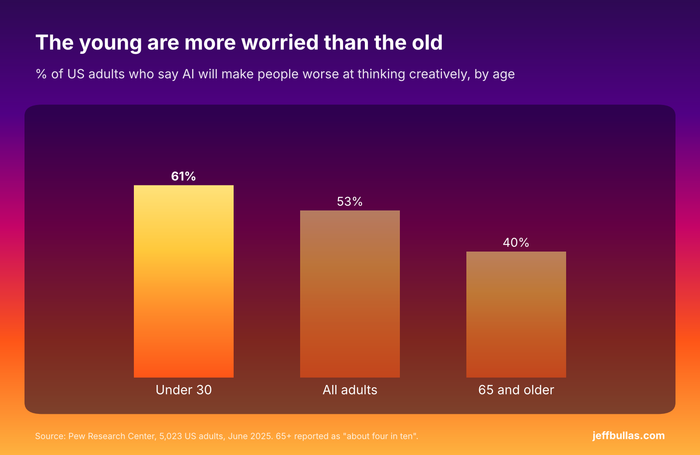
Jeff Bullas reports on 733 replies from about 675 people across three X posts asking how AI feels after 50. Of 279 replies to his core question, 53% said AI let them back in while only 1% said they felt simply left behind. The top theme was restored capacity, from a 57-year-old shipping a game port in five hours instead of six months to readers picking up coding, writing and music again. On dependence, almost one in five said it is already happening, with the most liked reply urging people to think first, then ask AI.
AI Ripples
Google Cloud launches the Gemini agent for work at Gemini at Work 2026 on October 8. It plans tasks, pulls business context and picks models with cost controls inside docs, inbox and dev environments.
Not to be outdone by Google's Gemini launch, OpenAI announced ChatGPT. Tibo shared the update on X as the Gemini agent news landed 😂
USA Today sues OpenAI over AI training use in Manhattan federal court on October 8, seeking over $250 million across 19 publications. The claim cites hundreds of thousands of articles used without permission and asks for model destruction alongside damages. It joins Times, Intercept and some 400 local papers in the same New York fight.
CONTENT
Ross Simmonds lays out a distribution engine that keeps one asset spreading for 90 days instead of dying in 48 hours. He ties the play to Foundation AI citation work showing brand-owned share stays thin.
Foundation tracked 5.1 million AI responses and 57.2 million citations across 50 B2B brands.
Only 10.15% of citations point to brand-owned domains, falling to about 2.2% for unbranded queries.
Analysis of over 8,500 bottom-funnel B2B keywords maps which subreddits win the SERP by niche.
Review of over 12,000 B2B pages finds stats and data formats earn links most often.
Ramp Economics Lab data now sits on the Bloomberg Terminal with pickups by NYT, WSJ, Economist, CNBC, and Reuters.
LinkedIn data shows 80% of top-company CEOs post online while sharers see up to 6x more profile views.
Paid boost rule holds $200 to $500 for winners only after organic proof.
LINK BUILDING + DIGITAL PR
Dan Petrovic explains why outreach links fail when placement breaks natural reader patterns, and lays out four rules for editorial integration.
A commercial model arrives months out of date because training data stops at its knowledge cutoff.
In a head-to-head grounding test Google received 7 pages and cited all 7, OpenAI received 39 and cited 2, and Anthropic received 14 and cited 9.
His model predicted expert link placements at a 93% confidence threshold and matched the author's actual links.
Organic content often carries 10 to 20 links per page while classic blog networks run 2 to 3 per post.
He lists 10 link purposes, from attribution and definition to proof and promotion.
SOCIAL MEDIA
Tim Jurka explains how LinkedIn pairs large teacher models with small efficient student models to catch AI slop as patterns shift. The team uses LoRA adapters to retrain fast without rebuilding models, plus agentic workflows that route hard calls to human reviewers and feed the answers back into policy. Classifiers now cover all posts distributed beyond the immediate network at 94% precision, and members saw 40% fewer views on flagged slop from just weeks earlier as of August 2026. He says user reports through the slop button now help tune the system.
Michael Stelzner and Adam Ivy break down the BINGE scripting framework for holding viewers past the first eight seconds. The method runs through a banger hook, intrigue build, forward nudges between points, engagement prompts and a fast ending that pushes to the next video. Adam warns against numbered listicles that let viewers feel done early, and favors useful but incomplete segments that close one loop while opening another.
Social Ripples
Meta is testing Reels-first openings on Facebook and Instagram with some users in India and Indonesia landing straight in full-screen video. Instagram users can pick Reels as the first screen, with a possible U.S. expansion in 2027.
Threads now awards Gems to top posts and replies that spark real discussion, judged on perspective, discussion and originality. The program is automated and limited to U.S. public posts for now.
X gave Grok Bots analytic search over posts to track product feedback, follow breaking stories and send industry roundups. Bots answer conversational queries and are priced around $20 per month.
Wired found Meta's Muse AI mapping personal contacts into a page per person covering family, friends and colleagues. The report landed as Muse passed 5 million downloads with 3 million weekly users.
WHAT I'VE BUILT FOR YOU
Floyi - Build Topical Authority that wins in Google and AI Search. Don’t just plan your content strategy - make it unstoppable.
ReplyDeck - Be active on Reddit without living on Reddit. Schedule replies, stay present in the threads that matter, and get your time back.
TopicalMap.com Service - Let us do the heavy lifting. We handle the research, structure, and strategy. You get a custom topical map designed to boost authority and dominate your niche and industry.
Topical Maps Unlocked 2.0 - Unlock the blueprint to ranking success. Master the art of structuring content that search engines (and your audience) love - and watch your rankings soar.
What Did You Think of This Week's Wave? |
LIKE DIGITAL SURFER?
Find me and others in the Digital Surfer Discord community.
I’d also love to know what you think and if you have any ideas for the newsletter. Reply or email me at [email protected].
I’d also appreciate it if you shared it with fellow digital surfers.
You currently have 0 referrals, only 3 away from receiving LinkedIn Shout-out.
Have a great week taking your SEO and digital marketing to another level!
And don’t forget to drag the Digital Surfer emails to your Primary Inbox 🌊
Reply