- Digital Surfer
- Posts
- AI Answers Rarely Mention the Brands They Cite
AI Answers Rarely Mention the Brands They Cite
Wave 313; Poisoned Google SERPs; Intelligent Shopping Carts; PDFs in Search; Site Migration = Site Quality Review; Bing Topic Portfolio; Local E-E-A-T; and Much More!

Yoyao
October 17, 2026 • Est. Learning Time: 15 minutes

FIRST …
I just published Part 2 of Floyi's Topical Authority Report.
Part 1 focused more on which websites AI answers cite as sources.
Part 2 focuses more on mentions and commercial + informational intents, across 42 topical maps, 27,122 queries and 38,723 answers from AI Overviews, AI Mode, ChatGPT, and Gemini.
A few findings stood out:
Rank #1 and get a 17.2% chance at a mention in AI Overviews, 14.2% in AI Mode, 8.7% in ChatGPT, and 8.6% in Gemini.
Rank #1 and get a 65.3% chance at a citation in AI Overviews, 54.0% in AI Mode, 24..9% in ChatGPT, and 29.1% in Gemini.
AI answers rarely mention the websites they cite, and most mentions come without a citation. 59.7% to 92.5% of the websites AI answers mentioned weren't cited in that same answer.
Brands get mentioned far more on commercial queries. Commercial answers carried 2.0 to 2.6 times as many mentions as informational ones.
Gemini had the most answers without any citations. They cited nothing in 45.0% of its answers, and 47.9% of those still named a website ranking in the topical map.
AI Overview had the lowest Domain Rating averages for the sites they cited and mentioned, while ChatGPT had the highest DR averages. The average DR is DR 39.9 per citation and DR 50.1 per mention in AI Overviews. In ChatGPT, citations average DR 53.6 and mentions are DR 70.6.
One more thing: 30% off the first year of an annual Floyi plan ends Monday, October 19. It's the lowest annual price we'll offer this year.
Log into Floyi and head over to the Settings → Plans to sign up for the annual plan.
Then use code: FLOYIYEAR30


Floyi is sponsoring SEO Reborn Summit '26, and we got a 50% off 1st month code just for you: SRS26FLOYI50
When: October 21 to 23, fully online
What: Three days on ranking in Google and showing up in AI search
Who:
Keynotes: Kaitlin McMichael (Amazon Web Services), Stewart Vickers (SEO Jesus), Kira Khoroshilova (Diary of an SEO)
Also featuring: Georgia Tan (Switch Key Digital), Adam Chronister, Olesia Korobka, George Blandford, hosted by Bibi Raven
How it works: Talks plus hands-on workshops where you build something from start to finish
Access comes with IMG Community membership, so you get every session. Use code SRS26FLOYI50 for 50% off your first month.
P.S. if you do sign up, you get access to a whole bunch of courses. If you haven’t taken my course yet, Topical Maps Unlocked is on there and one of the more popular ones. You’re able to get it and the summit talks for a great price.
SEO + GEO
Nozzle's research finds that rank trackers can mistake corrupted Google results for real ranking losses. Across 27.5 million SERPs collected from August 20 to October 9, 2026, 8.0% of SERPs since September 13 were poisoned, compared with 0.17% in the baseline. The study covers 49 countries and finds that most affected results return to their usual sites within days.
The result set can change without an error: On poisoned SERPs, only 20.7% of the previous results' sites remained, versus 88.5% in the baseline.
Tracked sites can disappear temporarily: A tracked site missed the top 10 on 58.6% of poisoned SERPs, against 2.7% in the baseline.
The mix of sites shifts: Reddit appeared in 28.8% of poisoned SERPs versus 20.8% of other SERPs for the same keywords. Facebook rose from 28.3% to 33.8%.
Most disruptions don't last: 77.9% of poisoned SERPs had their usual sites back within three days.
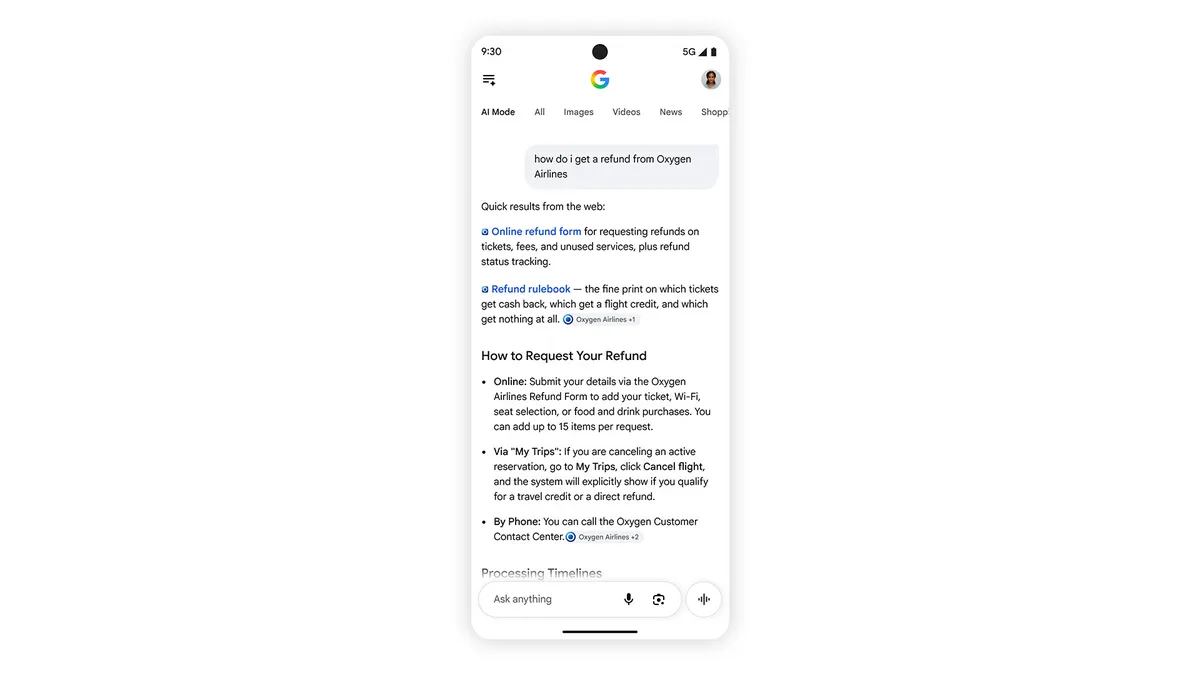
Google says they are adding more prominent inline links at the top of answers (image) and testing a dedicated section for official websites in AI Mode and AI Overviews. The updates also expand timely-news carousels and make links to related articles more visible. Google also says use of Preferred Sources has grown more than 7x since the start of 2026.
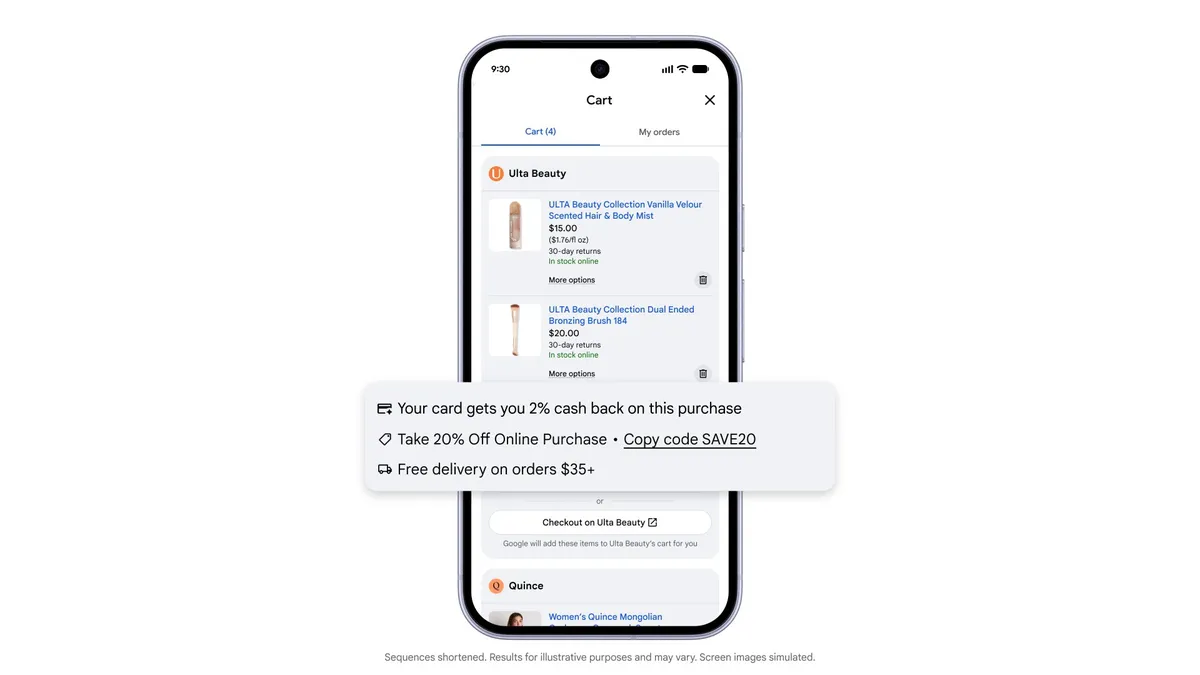
Google’s Universal Cart is now live in the U.S. across Search and the Gemini app. The cart saves items from multiple retailers in one place and builds on Google's Shopping Graph of more than 60 billion product listings, so price drops and back-in-stock alerts follow your list without you lifting a finger. Google Wallet powers the payment reasoning, surfacing promo codes and suggesting the best card or payment method from inside the cart. Checkout stays with Google Pay or transfers items straight to the merchant's cart, and partners like Nike, Sephora, Target, Walmart, Wayfair, and many Shopify merchants remain the seller of record with customer support direct from the store.
Martin Splitt and John Mueller of Google's Search Relations team walk through how Google really treats PDFs in Search Off the Record episode 115. Converted PDFs work like any other page, appearing in normal rankings, AI Overviews and AI Mode.
Google converts before it indexes: A converter component inside indexing turns the PDF's binary container into HTML right after rendering, so every downstream system processes it as a normal web page.
Size limits favor PDFs and stay undocumented: Martin assumes PDFs fetch with a larger allowance than HTML pages, on par with videos and images, and says Google deliberately avoids publishing exact thresholds because limits change.
Rasterized pages are the worst trap: Pages saved as images lose all text, which makes the PDF unindexable and hostile to screen readers, and a select-all copy that returns nothing gives it away.
Identical blobs break canonicalization: The same PDF file reposted on other sites registers as an exact duplicate, so link your homepage from the PDF header or send a rel="canonical" HTTP response header to point crawlers home.
PDFs get recrawled like images: Google assumes these files rarely change and refetches old URLs infrequently, so use a new filename when you genuinely update a live PDF.
CMS generation leaves stale copies: You can't edit a generated PDF like a CMS page, and auto-created PDF versions of pages can end up indexed against fresher HTML content.
Links and images behave differently: Links inside a PDF carry over to the converted HTML version, while embedded images get noticed but don't flow into image search the way normal image URLs do.
Mike King breaks down the Google Research paper behind Generative UI and makes the case that the results page is becoming one a model writes from scratch for each query. His answer to that world is measurement reform: treat every capture as one sample from a distribution.
Generative UI is already live: Google announced in November 2025 that the system, which writes a full page of HTML, CSS and JavaScript per query, was live in AI Mode for AI Pro and Ultra subscribers in the U.S.
Google committed to Search: The I/O 2026 announcement said Search can "build the ideal response, in the right format for your question" and promised generative UI capabilities to everyone this summer at no charge.
Users already prefer it: In the paper's human evaluations, the generated page was preferred over the top-ranked search result 90% of the time on LMArena prompts and 73.5% of the time on information-seeking prompts.
The reliability objection is fading: Output errors on the paper's test prompts fell from 60% on Gemini 2.0 Flash-Lite to 0% on Gemini 3.
Barry Schwartz reports Google has quietly rewritten its Indexing API documentation, deleting the default 200-request quota text, the request-and-approval language, and the advice to prefer the API over sitemaps for short-lived job and livestream pages. Three developer pages changed, while the public changelog mentioned only the quota page, an update Google says exists to document current limits and remove an outdated form. Some spotted the mismatch fast: Alexander Chukovski notes fresh service accounts still receive the 200 default, and Nick LeRoy's test returned a 200 status from the sandbox but a 404 from getMetadata, meaning submissions never reached Google's index queue.
Google Search Central opens its Non-Canonical Cabinet video series with Gary Illyes fielding a request to put an emoji in a domain name, which immediately collides with standards Google does not control. Domain names live under ICANN and IETF standards (RFC 1035 and 1123) that permit letters, numbers and hyphens, with internationalized characters converted to punycode, and they exclude emojis completely. The URL path is the loophole: web standards allow UTF-8 characters there, emojis included, alongside percent-encoding for the characters that carry special meaning. Googlebot can crawl and process emoji paths, but displays across browsers and tools are inconsistent, so the episode lands on the classic warning that just because you can put something in a URL does not mean you should. He recommends hyphens over underscores because Google treats underscore-joined words in a URL as one long word, and he dismisses keyword-stuffed URLs as an incredibly small signal that only matters for a site that is seconds old with no content.
Marie Haynes lays out a theory: a site migration triggers a fresh Google quality review, and today's standards at that review are much stricter. Her running case is a hobby blog that handled redirects, change of address, internal links, and sitemaps correctly, yet Page Indexing reports 98% of its URLs not indexed and even pages Google labels indexed inspect as crawled, currently not indexed. Search Console live tests on those pages returned that indexing was possible only under certain conditions, pointing at help text that page quality must be high enough to warrant indexing in the first place. Her underlying diagnosis is commodity content that adds nothing original over the rest of the web, with the fix she proposes being a small handful of genuinely original articles or, in the harder cases, a restart on a brand-new domain.
Bill Hunt tested what an agent can actually do on the top 122 Shopify storefronts, beyond declared tools and policy files, asking whether an agent can resolve a purchase decision rather than merely reach a checkout. Shopify installs the purchase path by default, while the merchant-owned rules required to answer buyer questions are missing almost everywhere.
The plumbing is platform-installed: 89 of 122 stores serve an /agents.md file, 83 of them near-identical copies of Shopify's template, and only 5 come written by the merchant.
The semantic floor wobbles: On 68 product pages, 47% carry at least one unlabelled input, 46% an empty link, 37% an empty button, and 65% of stores using dropdowns leave a size or option selector unlabelled.
The checkout layer works: All 74 live UCP checkouts completed every step, returning typed statuses, coded errors, confirmed single cancels, a refusal on a second cancel, and a handoff URL for a human.
But a human signs the check: Every one of the 74 checkouts ends requires_escalation flagged requires_buyer_input, matching Shopify's default rule that the agent builds the cart while a person commits the money.
Buyer questions break the tool: Asked about shipping cost to Boston, 1 of 88 stores' policy tools surfaced anything usable, cancellation reached 2 of 88, used or open-box returns only 5, and return windows answered cleanly in 70 of 88.
Delivery and pickup are invisible: Half of the 74 checkouts priced shipping to that Boston address yet none returned an arrival estimate or carrier, and all 93 stores declaring fulfillment list shipping only, even when the retailer clearly offers pickup.
Undo does not exist: Not one of the 122 stores exposes a tool to cancel, change or return an order after placement, since the UCP order spec defines reading an order and an event webhook but no operation to modify one.
Robots.txt leftovers bite: 51 of the 122 stores still block /policies/ via old theme templates, hiding their policy pages from crawlers that respect the file.
Microsoft introduces Topics Portfolio as a beta inside the AI Performance report, a personalized grouping of a site's grounding queries into clusters such as football, taxes or AI chatbots. Drilling into a topic separates the grounding queries you already appear for from opportunity queries where other sites get cited instead, all generated from your own AI Search presence rather than a generic ecosystem list. The beta caveats carry real weight: topic classification is AI-generated and imperfect, smaller sites may not see the feature at all, branded queries can sneak in as opportunities, and the counts are offered as directional signals for planning rather than a precise ledger. Thumbs up or down on every row and query feed the classification team's fix priorities directly.

Motoko Hunt names the global consistency paradox and the trade it bakes into enterprise sites: the more efficiently a multinational standardizes its web presence, the more completely it strips out the local signals AI systems use to establish expertise and authority market by market. AI engines retrieve and reconcile across many sources instead of trusting only the market site, so local evidence that never reaches the public web effectively disappears. Her rule of thumb is to standardize globally on company identity, brand standards, technical infrastructure, product definitions, design systems, and governance while keeping local expertise, certifications, customer stories, partnerships, reviews, and local research distinct to each market. Stating experience in a country is a claim, she adds, while surfaced local customers, subject matter experts and accepted certifications are the evidence that makes it creditable.
Reza Moaiandin ran six shopping and booking scenarios through Claude, with ChatGPT and Gemini comparison runs, across English, Arabic, Russian, Simplified Chinese, and Persian, totaling 1,650 responses that show the asker's language alone can flip the recommended brand. The sharpest swing sits in airlines, where Claude named British Airways its pick in 52.5% of Persian answers but never recommended BA once in Russian, where easyJet took 72.5% of recommendations. Hotels moved the same way: Bahía del Duque led 43.6% of Claude's Chinese answers against just 7.7% in Arabic, and Hotel Botánico held one-third of English answers with zero Russian showings. Stable categories barely flinched, with Roborock winning robot vacuum picks at 91.5% overall and Zoho CRM taking its category in every language, pointing toward contested categories as the places language bites hardest. In ten category and language combinations with web search on, the winning brand changed in seven of them, a hint that live web visibility moves recommendations in ways memory alone will not.
Barry Schwartz relays a domain-migration case where Google indexed the new domain smoothly by April, then four months later dropped more than 5,000 pages into crawled, currently not indexed, while re-indexing the old domain whose clicks and impressions reappeared in Search Console. John Mueller asked the owner for details by DM while offering two practical notes: processing can take a particularly long time, and Change of Address should be set up for both the www and non-www versions so the move can fully complete. The wider discussion raises a pattern, since there are repeated stories of site migrations failing months after a clean transition.
Maryanna Franco and João da Silva report an anomaly from 14,140 controlled API runs spanning 12 brands and five AI platforms: TALA, the U.K. activewear brand, got correctly filed under athleisure by every system probing its category, while Google's Knowledge Graph described the same name as a financial services company. That split defines what they call a KG-hijacked entity, where the Knowledge Graph result attached to a name resolves toward an unrelated organization, and in their tests the activewear brand appeared in none of the athleisure or sportswear recommendation responses. They place the failure upstream of the usual recognition-recommendation gap, because a label can refer to multiple organizations and a strong structured anchor can attach the wrong one's attributes. The remedy they sketch is disambiguation work that makes a brand's distinctive site, organizational details, relationships, and third-party references coherent enough for systems to tell same-named entities apart.
Dan Taylor's prediction model, trained on 25 years of Google update timing alongside this year's rollout calendar, returns a 96.8% chance of an official update within 30 days, best matching the stretch from late October to mid November. The window leans on no broad core update having run since May 2026, with August and September reserved for targeted spam updates and Google leaving a three-to-four week gap before the holiday code freeze. Panda, launched in February 2011, was a site-level quality classifier built on human judgments rather than a word-count rule, and he expects this cycle to aim at pages produced to rank, fabricated authors and answer-steering listicles instead of page length. Google's guidance has shifted in parallel, now treating manual fact-checking of generated output including titles, meta descriptions, structured data, and alt text as critical, unreviewed scaled AI content as little-to-no-effort, and fake author bios as outright deception.
SEO + GEO Ripples
Google's News AI pilot reaches 400 publications licensing enhanced content for AI features. New partners include Axios, CNN, The Financial Times, and Forbes alongside smaller outlets like the Texas Tribune. Google pays participating publishers for content that powers article overviews on Google News pages and customizable audio briefings, all with attribution and direct links back to the source.
AI
Google introduces Gemini 4 Argon, their latest frontier model now available through the API, Antigravity, the Gemini app, and AI Mode in Search. It ranks first on the Vals Index across finance, coding, legal, and tax work and it's built for long multi step tasks with a 1M unified input-output token limit. Introductory pricing sits at $2 per million input tokens and $10 per million output tokens, with cached input at 95 percent off. Inside Google, Argon lifted agentic code submissions by more than 35 percent while cutting rollbacks by nearly a third, helped untangle a 6 million line Chrome legacy folder in weeks instead of months, and cut ADK session prep time by 40 percent with 21 percent faster cold imports.
Cedric Huesler traces a week of vanished ChatGPT referral data to a link-tagging bug inside OpenAI's browsing pipeline, now confirmed and fixed. From October 8 to 15, ChatGPT links stopped carrying utm_source=chatgpt.com, attributed visits fell to about a third of normal, and analytics quietly counted the missing traffic as direct. By the morning of October 15, tagged ChatGPT clicks were back to roughly 95 to 100% of the same hour the prior week across thousands of domains in his telemetry. His reporting advice is to annotate October 8 through 15 in GA4 as one event rather than a trend, leave the attribution model alone, and keep relying on the UTM because the referrer is still missing on most ChatGPT clicks.
Eric Siu lays out the AI operating model he runs at Single Grain, built on skills for repeatable processes, evals that define what done looks like, and loops that learn over time. The premise is a single shared brain his team can query so knowledge compounds instead of leaving with whoever holds it.
Knowledge walks out the door: Panopto research cited in the post finds 42% of institutional knowledge is unique to the person holding it, so colleagues can't do 42% of their job after they leave.
Most teams capture none of it: BCG data across 1,250 companies shows only 5% achieve AI value at scale while 60% get little or none despite heavy investment.
One skill's compounding curve: His X long-form skill took the account from 180,000 impressions in January to about 3.1 million by June.
The format became a standard: Anthropic released Agent Skills in late 2025 and OpenAI added support in ChatGPT and Codex.
Evals gate every draft: The X skill's humanizer scores drafts starting at 100 and ships nothing below 90.
The sponsorship loop answers for him: His “Mr. Siu” loop fields about 20 sponsorship requests a week, quotes $25,000 per video, and taught itself to send guidelines and media kits.
A finance skill paid fast: A CFO skill ran about 30 minutes, flagged double spending, and he cut those costs within three days.
AI citations squeeze the click: Pew's analysis found Google users clicked a traditional result in 8% of visits when an AI summary appeared, against 15% when none did.
Share of voice moved: One of his customers went from about 5% to 20% share of voice in AI search on a loop like his AEO workflow.
AI Ripples
Microsoft is testing its new Microsoft-Decision-1 decision-scoring model in Copilot and Bing. The model targets routing, classification, prioritization, verification, and workflow control while claiming top latency and quality on structured decision tasks, and both the Copilot and Bing teams confirmed live experimentation on X. Decision models are the hot new thing.
SOCIAL MEDIA
Evan Bailyn and the First Page Sage research team report LinkedIn ad conversion benchmarks built on 1,240 campaigns from 186 North American and European advertisers, spanning $38.4 million in spend and about 2.9 million clicks. Lead Gen Forms convert about four times as often as website landing pages.
Two formats led everything: Document Ads converted best at 14.7% on Lead Gen Form rate, followed by Thought Leader Ads at 13.1%, while Video Ads trailed the field at 9.6%.
Form conversions are slipping: Lead Gen Form conversion fell 1.3 percentage points across the study window, from 12.5% in Q1 2025 to 11.2% by July and August 2026.
Landing pages held steady: Website landing page conversion stayed in a 2.8% to 3.3% band for the entire 20-month span.
Industry gaps are wide: Higher education converted best at 15.6% with the lowest cost per lead at $72, while legal converted worst at 8.7% and paid the most at $246 per lead.
Offers decide the SQL math: Original research produced the lowest cost per SQL at $1,153, with demo requests converting lowest at 4.8% but qualifying at the highest lead-to-SQL rate of 22.7%.
Ebooks look good until you check: Ebook conversions read healthy at 15.9% form fills while the offer's $1,805 cost per SQL ranks second worst in the dataset.
Seniority costs you clicks: Conversion rates fall steadily with rank and company size, from 14.8% for entry-level members at companies of 50 or fewer down to 7.1% for C-suite members at companies over 5,000 employees.
LinkedIn announces new networking and earning tools built around the platform's work shift, with the number of founders up 70% and the share of members holding more than one ongoing position up 26% since 2019. The relationship tools include a Network feed test in the U.S., India, the U.K., and Australia that gathers posts from connections and people you follow in one place, personalized digital business cards rolling out globally over the coming months, private profile notes for Premium subscribers, and comment pinning for post authors. On the earning side, a new all-in-one creator dashboard rolls out globally in the coming weeks, and an In-Stream Ads test pays select U.S. creators when pre-roll video ads run alongside their eligible videos. Advice Sessions lets Business Premium subscribers in the U.S. sell 1:1 consultations straight from their profiles, with bookings, payments and video hosting handled in one place. LinkedIn notes more than 80% of its creators already build content alongside another role.
Social Ripples
YouTube Music is rolling out labels for AI-generated music that sit right on the player page when AI played a significant role in a track, like a generative model producing the composition or vocals. YouTube tags tracks with music partners and its own detection tools, and the labels will expand to the main YouTube app.
BUSINESS IDEAS
Philip Ghezelbash makes the case that AI use alone is not disqualifying for an Amazon KDP acquisition, as long as the disclosure trail, book quality and transferable workflow all check out. Amazon allows AI-generated books and even sells AI translation and virtual-voice narration itself, but since September 2023 it requires disclosure of AI-generated text, images or translations, counting content as AI-generated even after substantial edits. The critical buy-side check is proof: a title-by-title breakdown of how each book was made, the actual Amazon disclosure answers for top sellers, and a read-through of the top five to ten titles rather than trusting AI detectors. A wrinkle on ownership comes from U.S. copyright, where a January 2025 Copyright Office report says raw AI output may carry little or no protection, shifting deal value toward listings, reviews and rankings. On the economics side he flags that KDP businesses have sold at an average 2.2x annual net profit over the past three years, so treadmill catalogs dependent on constant new uploads may not outlast the payback window.
WHAT I'VE BUILT FOR YOU
Floyi - Build Topical Authority that wins in Google and AI Search. Don’t just plan your content strategy - make it unstoppable.
ReplyDeck - Be active on Reddit without living on Reddit. Schedule replies, stay present in the threads that matter, and get your time back.
TopicalMap.com Service - Let us do the heavy lifting. We handle the research, structure, and strategy. You get a custom topical map designed to boost authority and dominate your niche and industry.
Topical Maps Unlocked 2.0 - Unlock the blueprint to ranking success. Master the art of structuring content that search engines (and your audience) love - and watch your rankings soar.
LIKE DIGITAL SURFER?
Find me and others in the Digital Surfer Discord community.
I’d also love to know what you think and if you have any ideas for the newsletter. Reply or email me at [email protected].
I’d also appreciate it if you shared it with fellow digital surfers.
{{rp_personalized_text}}
Have a great week taking your SEO and digital marketing to another level!
And don’t forget to drag the Digital Surfer emails to your Primary Inbox 🌊
Reply