- Digital Surfer
- Posts
- Getting Cited Rarely Gets You Mentioned
Getting Cited Rarely Gets You Mentioned
Is GEO a Distraction?; AI Visibility Audits Audited; YouTube AI Cited Video Commonalities; AI Meets Javascript; Citation Worthiness; and Much More!

Yoyao
October 24, 2026 • Est. Learning Time: 20 minutes

FIRST …
If your website ranks in the top 20 for topics in your map and an AI answer cites you, there's only a 4.6%-7.6% chance that answer also mentions your brand.
So is it still worth ranking?
And where should you focus to get mentioned?
That's what we dug into in Part 2 of the Topical Authority Report, covering 38,723 AI answers (AI Overviews, AI Mode, ChatGPT, Gemini) across 42 topical maps.
Rankings are still worth it.
Citations stay closer to the search results than mentions do, and the higher you rank, the more often you tend to get mentioned.
But rankings alone won't get you mentioned.
Even a site ranked 1st is mentioned in only 8.6%-17.2% of answers that mention a ranking website.
And of the brands AI answers do mention from your map, most rank for other topics in it, not for the query itself.
So the sites ranking next to you on Google aren't a reliable guide to who AI answers mention for that query.
The data can't tell you what causes a mention.
But it does show where mentions cluster, so here's where to start this week:
Pull 10 commercial topics from your topical map. Commercial answers mention 2.0-2.6 times as many brands as informational ones. Use your map instead of a keyword list, because each topic in a map has a unique search intent, so you're not running five versions of the same query and skewing the results.
Run them and log citations and mentions separately. Use the AI engines your buyers use, and note every brand cited and every brand mentioned in each answer.
Tally who gets the most mentions. Those brands are your real competition for mentions, whether or not they outrank you on Google.
Work your 4th to 10th-ranked commercial pages into the top 3. On commercial queries, a top-3 site gets mentioned in 10.1%-18.0% of answers that mention a ranking website, against 4.3%-7.8% for one ranked 4th to 10th.
For a bigger challenge, run your whole map and all the commercial topics.
Across a full map, 50% of all mentions go to about 10% of the brands that get mentioned, and that short list is now your benchmark.
Which brands would top your mention list today?

SEO + GEO
Rand Fishkin summarizes three studies (from Marie Haynes, SEO Works and Kevin Indig - next 3 links) through his 5-Minute video on LinkedIn, saying a full day with all of them left him less confident than ever that growing AI visibility in ChatGPT, Claude, Perplexity or Copilot will move the needle for most companies. His carve-out is the Google side of the house: AI Overviews, AI Mode and Gemini are a different story and probably do matter, in his view. Whitespark's Darren Shaw pushed back in the comments with self-reported attribution data showing ChatGPT as the number one source new customers named. Lily Ray warned that most GEO tactics are exploits inside the models that will get patched, with companies already sitting through months-long Google recovery after living on them. Marie Haynes joined the thread and read Kevin's findings as answering the brand-visibility pushback her article has drawn.
Marie Haynes ran the GEO question against her own 12-month GA4 dataset covering 100 websites and over 145 million sessions. Sessions from ChatGPT came in at 0.62% of Google organic's volume across the set, rising to 0.73% with every other LLM included. Visitors from ChatGPT converted at 13.8% versus 3.02% for organic among the 55 sites in her dataset that track conversions, yet Google still drove 96.5% of total conversions and 27 times more than all LLMs combined. She notes ChatGPT's exponential growth curve broke in August 2025 around the GPT-5 release, and it has sent fewer visitors to websites since. Her thesis is that the AI search actually sending people to businesses is Google itself, so her piece turns toward the agentic web instead, listing Google's Universal Cart, the Universal Commerce Protocol, WebMCP and Intelligent Eyewear as the surfaces worth preparing for.
SEO Works built its AI Referral Traffic Benchmark on 12 months of GA4 sessions across 95 websites, September 2025 to August 2026, with the conversion set covering 63 of them.
Volume dominance: organic logged 2,825,594 sessions against 72,095 AI sessions, leaving AI at 2.6% of the combined total and organic at 97.5%.
Conversion: AI came in at 7.18% against 6.08% for organic, a 1.18x ratio (median 1.21x) and a fraction of the 4.4x and 23x multiples circulating from single-company and publisher-built studies.
Spread: 23 of the 63 sites in the conversion set converted worse on AI traffic, and 5 sites logged zero AI conversions across 1,487 sessions.
Raw counts: AI produced 5,001 conversions against 155,605 for organic, 3.2 per 100.
Baseline: AI converts at 0.67x of paid search, 1.37x of all channels and 2.48x of direct traffic, the pattern behind the report's warning that a multiple published without its comparison channel is unverifiable.
Floor logic: AI Overviews arrive as organic sessions and stay out of the AI channel, so every multiple in the report undercounts AI traffic.

Kevin Indig went hunting for AI traffic hidden inside direct visits in GA4 across 12 websites and came back with bots, tempting correlations and a null result. Total direct sessions rose 140.9% in his August-to-September window while engaged direct traffic stayed flat, and one site logged 409,000 direct sessions with only 198 counting as engaged, leaving identifiable AI traces at 0.003% of direct traffic. In 632 weekly tests across four brands, he compared AI visibility against branded search and direct traffic at delays out to six weeks, and no result held together under shifted-control comparisons even where a 0.72 correlation looked promising at a three-week lag. The counterpoint sits one layer up: on the Siege Media Podcast, Ramp's Eric Wu described catching long blog URLs inside direct traffic, matching their behavior to search visitors and using self-reported attribution to place 30% to 40% of Ramp's direct traffic with answer engines. Kevin's verdict is that analytics can't yet show this connection unaided, so the working method is triangulation: track where the brand appears, ask new customers how they discovered you and connect those answers to revenue.
Mike King took the previous three studies on at iPullRank, accepting their numbers and objecting to the conclusion: all three grade a brand channel with a traffic ruler, the same as judging a Super Bowl ad by click-through rate. The reach numbers carry the argument: ChatGPT at 1.2 billion weekly users, up from 900 million in February, with Google's AI Mode past a billion monthly and AI Overviews reaching 2.5 billion. His evidence pile against the referral report includes Semrush pegging AI Mode at roughly 93% sessions ending with no click, and Pew's panel finding an 8% click rate on a traditional result when an AI Overview appears. The referral report undercounts too: about 70% of AI traffic lands in analytics as direct, and ChatGPT mentions brands 3.2 times more often than it cites them. His ask is a channel shift: budget AI search like brand, not like performance, and measure it with share of voice, mention frequency, citation position and sentiment, plus branded search, direct traffic and self-reported attribution as the lagging outcomes.
Glenn Gabe retested AI search platforms against JavaScript-rendered content 434 days after his August 2025 post, asking ChatGPT, Claude, Perplexity, Gemini, and Copilot to read each page and return the first and last paragraphs. ChatGPT, Claude and Perplexity still came back with page shells, navigation and error messages instead of main content, while Gemini and Copilot could read most pages because both tap Google and Bing's search systems. The one surprise came on a parallax site built with WebGL, where Copilot failed and saw nothing beyond the error text despite the Bing backing. He keeps the warning from last August: be very careful with JavaScript-based content, and don't rely on client-side rendering for anything you want AI search platforms to read.
Cloudways' new AI adoption report flags a visibility gap: a site can rank first, publish strong content and still vanish from the AI answer that shapes a purchase. Its survey covered 1,000 digital and e-commerce decision-makers across the UK and US.
76% say AI Overviews have already reduced their website traffic in the past 12 months.
80% believe technical website performance now plays a greater role in online visibility than content alone.
Every minute of website downtime costs a digital business an estimated $945, or $56.7k per hour.
Only 9% continuously test their infrastructure through automated monitoring.
Luke Harsel reports the fastest AI Overview expansion yet across commercial queries, with the summary now standing in for the comparison, pricing and review pages buyers relied on. Semrush tracked a fixed keyword panel from September 2025 through August 2026.
Keyword-weighted coverage across all 400 tracked keywords reached 88% in August 2026, up from 45.75% in September 2025.
Volume-weighted coverage hit 97.08%, since the 12% of keywords still without an AI Overview account for less than 3% of tracked demand.
Review searches jumped from 30.14% to 90% coverage, the largest modifier increase at 59 points.
Best X for Y searches finished as the most covered modifier at 96.12%, up 53.4 points.
Brand vs brand searches grew the least at 23.18 points even though they started highest in the panel at 63.41%.
Alternatives searches climbed 34 points to above 82%.
Ecommerce rose from 32.62% to 85.11%, the largest industry shift, as banking, ecommerce and software all landed between 85% and 91%.
Three industry-modifier pairings reached 100% coverage: best X for Y in banking and software, plus alternatives in software.
Banking alternatives (65%), ecommerce pricing (71.43%) and software reviews (75%) remain the only pairings below 80%.

Shadrack Wanjohi analyzed 83,835 YouTube citations pulled from 182,631 AI answers captured across Google AI Mode, AI Overviews and ChatGPT between June and September 2026, and finds video citations are mostly a Google question. The long tail matters too: more than a few most-cited videos came from small channels whose titles read like the buying question.
98.2% of YouTube citations came from Google AI Mode and AI Overviews, which cited YouTube in 36.0% of answers versus 2.1% on ChatGPT.
Best-of prompts on Google surfaces pulled YouTube in 46.5% of answers, against 19.1% for pricing and cost questions.
Best or top appeared in 59.4% of the 100 most-cited video titles, compared with 10.3% of videos cited only once.
Five-to-15-minute videos made up 72.0% of the top-150 most-cited group versus 43.4% of the cited-once group.
Nearly half of Google's YouTube citations (48.4%) carried a timestamp, and 71% of those pointed inside the first five minutes.
Channel size failed to predict citations, with correlations of -0.08 for views and -0.07 for subscribers, and 42% of the top 150 coming from channels under 10,000 subscribers.
Descriptions with three or more timestamp lines appeared on 56% of the top-150 videos, against 33.1% of the cited-once group.
Citations stayed dispersed across 17,780 videos: the top 100 held 12.6% of appearances and 52.7% of cited videos appeared in a single answer.
Uploaded captions showed no citation advantage, appearing on 14% of the top group and 16.6% of the cited-once sample.

Andy Crestodina collected 100 free AI visibility audits the way any marketer would find them, through Google searches, best-tool roundups, Product Hunt launches and cold LinkedIn messages, then graded what each one actually checks before claiming to measure your visibility.
58% of the audits run AI prompts built from scanning your own website, so the tool grades your page on answers written from your page.
Averaged scoring weights across the 14 tools that publish methodology put technical architecture at 46%, content and structure at 33%, in-AI answers at 19% and off-website factors at 2%.
The 18 ungated tools returned scores from 28 to 100 for orbitmedia.com alone.
Only 3% of audits address buyer personas, while 65% lean on checks labeled technical in the study's empathy-to-mechanics ladder.
Most audits ask for nothing beyond a URL, and the deeper input options top out at a product description, a company blurb or a sample prompt.
Indie developers built 12 of the 100 audits, most of which don't even ask for an email address.
Agencies ran the seven audits that demanded a sales call before showing results.
Four builder types fill the set: agencies as lead magnets, AI visibility software previewing paid trackers, SEO suites chasing signups and links, and vibecoded indie tools.
My Take: The missing layer in these tools is the brand and its buyers, so the score you get back grades plumbing while the real question is whether your content answers what customers actually ask. That’s exactly why Floyi starts with setting up your brand foundation and buyer personas. Everything else downstream builds off of them.

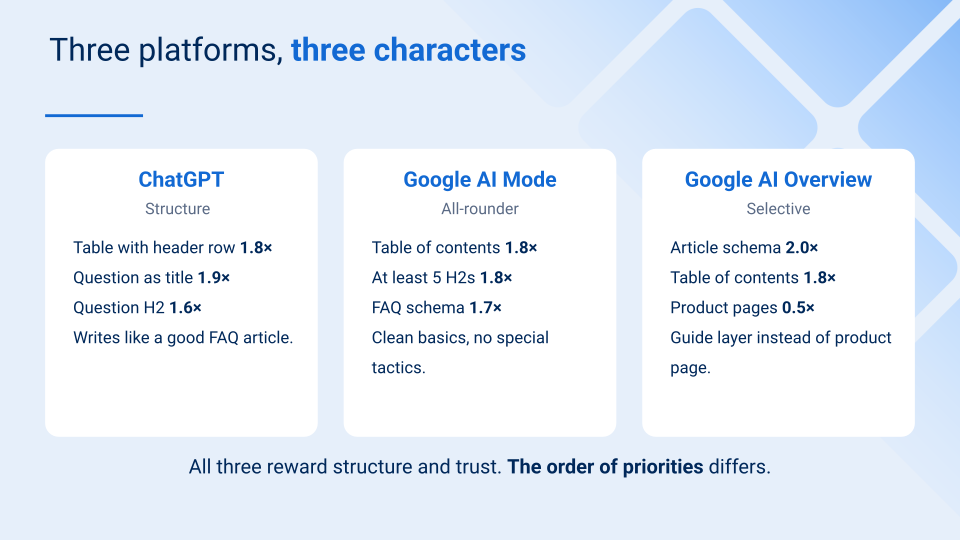
Johannes Beus and Julia Weissbach ran the largest GEO factor study this wave, testing 43 on-page features against AI citations with a matched-pair design. Every cited page from the Sistrix AI Index got compared against a non-cited page from the same domain, so brand strength drops out of the equation, and 96,418 URLs across 17,380 domains went under the microscope.
The current year in the title was the strongest retrospective signal at 2.7x, while pages stuck with an older year came in at 0.7x.
A visible table of contents lifted citations 1.7x (only 14% of pages carry one), Article schema delivered 1.6x, and FAQPage schema ran at 1.5x across all three platforms and all domain types except encyclopedias despite Google dropping FAQ rich results.
Trust signals helped as a set: an author box with photo (1.4x), a visible last-updated date (1.3x, shown on just 5% of pages) and at least ten external links (1.3x).
Combining eleven features produced a 2.1x overall effect for heavily optimized pages and 1.6x for mid-range ones, with only 10% of cited pages already meeting many of the checks.
llms.txt showed no measurable advantage, with 11.7% of cited URLs coming from domains that carry one against 14.0% across all domains.
Recipe schema came in as the worst performer at 0.1x, while Breadcrumb, HowTo and QAPage markup showed no effect at 1.0 and Flesch readability landed at 1.03, which the study marks as not significant.
Platform splits diverged: ChatGPT favored question-shaped content (question-title pages at 1.9x), AI Mode rewarded clean basics with table-of-contents and five-or-more-H2 pages at 1.8x each, and AI Overviews went selective, citing Article-schema pages twice as often but product pages only half as often.
Shops reversed the playbook, with last-updated dates (0.7x) and Product schema (0.6x) tracking to fewer citations, which points ecommerce at an advice section built on Article schema instead.
The study-run data grounded the trust floor: FAQ schema went from 23% less common on cited pages at 833 URLs to 31% more common at 4,600 before settling at 19% more at 96,418, which is why Sistrix says to distrust any GEO study under 5,000 URLs.
Ethan Crump tracked what happens to AI Overviews once commercial intent gets added to brand searches, using the Foundation B2B Citation Index powered by Writesonic. The set spans 1,235 prompts naming exactly one brand plus buying words, run weekly for 13 runs from June 29 through September 21, 2026, for 45,992 answers across Google AI Overviews, AI Mode and ChatGPT.
Across 15,716 AI Overviews on branded buying searches, 21.7% cited a direct competitor's own site, and 11.9% cited the competitor while omitting the brand the buyer named.
The rate sits roughly 12x the 1.8% Ahrefs found on bare global brand searches, and the weekly figure swung from 12.7% to 30.2% across the quarter.
Alternatives searches led at 35.8% competitor citations while the brand's own site appeared in only 32.9% of those answers, with pricing back at 13.4% (the brand cited in 75.7%) and reviews at 7.8% (the brand at 61.4%).
The source mix flipped on buying searches: Wikipedia dropped from 71.9% on bare brand names to 0.9%, review sites such as G2 and Capterra showed up in 58.8%, Reddit in 46.4%, and the brand's own site in 52.4%.
The winning pages shared a pattern: the title matches the search, prices and limits sit in tables and summary blocks Google can lift, the named rival gets credit before the pitch, and the publisher plants itself in the closing comparison table.
Google Search Central published a new robots.txt explainer in its Non-Canonical Cabinet series, pulling the strangest questions from its event Q&A backlog and answering them against the RFC 9309 standard. The parser reads robots.txt line by line and accepts only user-agent, allow, disallow, and sitemap lines, silently discarding the rest, so a hand-written "don't crawl secret page" directive does nothing to stop Googlebot from finding that page. User-agent tokens take only letters and dashes, so no emoji and no non-English characters belong there, while paths built from umlauts, Chinese characters or emoji should be percent-encoded, which the video demonstrates by writing a chicken emoji as %F0%9F%90%94, because a crawler that cannot translate the raw character may ignore the entire disallow line. On AI crawlers, robots.txt is an access-preference protocol, so it decides who crawls and says nothing about what a system does with the fetched content afterward, and the only real way to keep an AI bot out is to name its user-agent token explicitly.
Lawrence Hitches analyzed 14.9 million Google Search clicks across 100 ecommerce sites and found category pages taking two-thirds of the traffic at the median site, despite stores carrying roughly nine product pages for every category page. In more than 12,000 queries where both page types from the same store competed, Google showed the category page more often on 61% of them, and each site's highest-demand queries leaned category by a median 13 percentage points above its own average. The dividing line ran through query intent rather than volume or singular-versus-plural wording: "bike lights" went to the category page 97% of the time while "frog light" went to a product page 98%, and singular searches still favored category pages 60% of the time. His shelf-ratio framework starts by deciding whether you are measuring demand from people who already know you or people who don't, because stripping branded queries swung one fashion label's category share from 72.1% to 11%.
Nick LeRoy walks through how he would spend $100,000 building a website in 2026, opening with affiliate-era receipts that peaked at $3,000 to $5,000 a month in car insurance lead generation and concluding the Google-dependent playbook is dead. His remake starts with audience research across Reddit, Quora and real conversations instead of keyword exports, then allocates real budget: $25,000 to buy an advantage such as a radio-test domain like SEOJobs.com, $15,000 into what AI cannot easily replicate, meaning proprietary datasets, tools and credentialed research, and $20,000 or more into distribution built on relationships, the route that gets his listings into big newsletters and Slack communities. Operations and experimentation get $10,000, a lesson the same insurance site taught the hard way when single-revenue-model payouts slid from $13-15 to $1-3 per click and the site followed, while $30,000 stays in reserve. The thesis underneath is blunt: build something people actively seek out, return to and recommend, so search still matters without being the only thing keeping the lights on.
Barry Schwartz reports that Google rolled out a closed beta of Business Home, a dashboard at business.google.com that unites Business Profile, Merchant Center, YouTube and Ads accounts in one place, with access limited to selected business categories in the US and UK over the past couple of months. Google pitches the portal as a growth partner built with Gemini models, promising personalized advice, multi-location management and the ability to create, publish and track content from a single surface. The system detects real-time demand surges and helps businesses publish seasonal offers across social media. You can try accessing it yourself at business.google.com/create?flow_id=bh.

SEO + GEO Ripples
Google Images and Discover still skip JPEG XL. John Mueller noted on Bluesky that Google Images and Discover give JPEG XL no support, with Google's help doc still listing BMP, GIF, JPEG, PNG, WebP, SVG, and AVIF as the formats that work. Glenn Gabe found .jxl files indexed anyway after a filetype query, mixed in among other formats. The format's pitch of up to 50% better compression is what keeps teams trying it.
Google Business Profiles tests government ID verification. Digital Jedi surfaced a new flow asking managers to upload a photo of their government ID, with Google promising the image is only used for verification and never shown publicly. The method is absent from Google's help doc alongside phone or text, email, live video call, and mail, and Barry Schwartz suspects it pairs with Local Service Ads certification for certain professions.
AI
Block introduces Dessa, a full-duplex speech-to-speech model trained from raw human conversation with no text or pretrained models. Dessa chooses what to say, when to interrupt and how to say it, according to Block, while natively processing emotion, sarcasm, laughter and pauses that speech-to-text systems discard. The model runs faster than real time on a MacBook Pro M4 Max or better, and Block says it trained the model with one NVIDIA GB200 NVL72. The team is offering a small group of AI safety researchers early access to probe risks that a speech-only model may introduce.
My Take: Listen to the demos on the site. Wow. The best speech model I’ve heard yet.
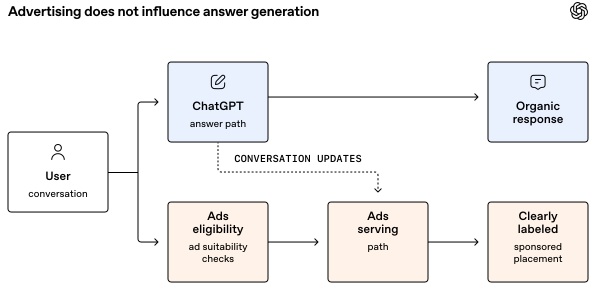
OpenAI engineers walk through how they built an ad stack for conversations instead of single search events. A post-trained frontier LLM they call the orchestrator runs the whole flow in an agentic loop, rewriting the conversation into retrieval queries, pulling candidates, filtering for eligibility, scoring relevance and predicted engagement, then nominating winners to an auction tool it never controls directly. Ad selection runs in a separate service with separate models and separate code, so the ads system never touches ChatGPT's answers and cannot take the product down or slow it. Returning no ad is an ordinary successful outcome, and an ad only reaches the screen if it arrives before ChatGPT finishes writing its response, below the answer and clearly labeled sponsored with a neutral model-generated preamble. The stack reached $1 billion in annualized revenue run rate less than 200 days after launch, and more than 100,000 advertisers have run ads on ChatGPT since.
Marcel D. reports that Walmart is opening checkout to AI agents through its Agent Gateway, an MCP server that lets approved agents search products and complete purchases across Walmart and Sam's Club inventory. Compatible agents include Meta's Muse, ChatGPT and Gemini, and Walmart built detection to distinguish agent-led purchases from the customer's own transactions. Agent Profiles roll out next month, giving each agent its own profile inside a Walmart account with separate purchase visibility, per-transaction approval or a spending cap, deletion at any time and no Walmart+ membership requirement. He contrasts the move with Amazon, which has pushed agents out of its storefront, and notes Walmart's terms bar agents from exceeding shopper intent, touching payment information or pulling more data than the task requires, with standard returns still applying when an agent makes an error.
AI Ripples
Meta's Muse reached 10 million US downloads in 40 days, a pace only a dozen apps have ever hit, crediting strong retention and a heavy paid-promotion push. Meta funneled nearly two-fifths of its October ad budget into the app, and daily actives cleared 2.5 million by mid-October.
Gemini brings Personal Intelligence to cars globally on Android Auto and cars with Google built-in, connecting Gmail, Google Calendar, Google Photos, and Maps once you opt in your apps. Flight-gate lookups, errand navigation and photo-based destination asks now run hands-free while driving. The first rollout skips the European Economic Area, Switzerland, the UK, and Nigeria.
CONTENT
Roslyn Ayers lays out the listicle makeup that earns reader trust, built on transparent selection criteria, original expertise and evidence-backed recommendations. The AI angle is explicit: listicles carrying summaries, comparison tables and methodology sections are often easier for AI systems to interpret and cite than pages weighted toward copy or engagement features.
Mine Search Console keywords for modifiers like "how to," "best," "vs.," "alternatives," and "mistakes" to seed topics, then repeat the export against competitors through Ahrefs or Semrush.
Use her title formula of item count plus qualifier plus list type plus benefit, in the mold of "11 Best SEO Tools Our 90+ Person Agency Actually Uses."
Open with a table of contents with jump links or the full list up front, which Ayers notes also feeds AI Overview and LLM inclusion.
Number every item under the same heading tag and template each entry around what it is, where to get it, who it is best for and its drawbacks.
Add list schema alongside the usual site, article and FAQ schema.
Make the featured image a snapshot of the whole list and place an image in every section, which Ayers calls the most underrated way to take SERP real estate from competitors since images often appear in AI Overviews.
Lead with a summary of the top one to three picks and the reasoning, then hold one comparison-criteria template across every item so readers compare like for like, with a "who it is not for" section as the pattern-breaker.
Publish the trust mechanics: breadth of options considered, scoring framework and weighting, real photos or screenshots, firsthand results, experts consulted and the rejected options with reasons.
LINK BUILDING + DIGITAL PR
Miloš Radić rebuilt his link building prospecting around a swap: ranking third-party pages by how often AI answers cite them instead of Domain Rating alone, after a first competitor intersection returned 311,000 domains and live Ahrefs queries burned API units fast. Vibe coding an AI agent over a week of evenings produced a local web app that loads roughly 24,000 filtered domains into an opportunities board, tags each row as competitor-linked and cited, AI-only or backlink-only, and floats the couple hundred most actionable rows to the top. The app handles contact discovery under a never invent an email address guardrail, runs a four-touch Lemlist sequence across LinkedIn and email over about eight days, and posts replies to Slack with the exact article targeted. His opening campaign across 760 targets delivered a 58.6% open rate, a 15.3% reply rate and a 31.9% LinkedIn invitation acceptance rate, with the flagship example a low-DR ZenPilot comparison post that AI answers cite and that leaves out his employer's product.
SOCIAL MEDIA
AliExpress announced a global strategic affiliate partnership with YouTube that wires marketplace inventory into the platform's creator affiliate ecosystem, expanding from a March 2026 launch in South Korea into the United States, Brazil, the United Kingdom, and Germany. Participation runs through YouTube Studio for creators who meet the shopping affiliate requirements, and product tagging spans long-form videos, Shorts and livestreams, with emphasis on the Brand+ catalog of branded goods. Shoppers link straight from YouTube to AliExpress to complete purchases, and further markets arrive in phases as YouTube's affiliate program expands.
Tamilore Oladipo opened up the actual rates three Buffer content teammates charge brands for sponsored posts, drawn from more than 50 brand deals between them.
October 2026 rates: LinkedIn text or single-image posts at $500 to $1,000, carousels from $700 to $1,300, and short videos from $900 to $4,000 depending on production.
Follower-count pricing breaks down on inspection: at $10 per 1,000 followers, Oladipo's 25,000-strong feed would price a text post at $250, against the $650 she actually starts at.
Kirsti Lang's short-video workflow runs about 11 hours each, which works out to $80 to $110 an hour at her $900 to $1,200 rate.
Sabreen Haziq prices production over audience, quoting $1,500 for a straightforward talking-head video and up to $4,000 for one that needs hand-built animation or a difficult edit.
Running a post as an ad adds 30% to 60% to the base rate across the team, and Haziq charges about $400 a month on retainers for ongoing usage rights.
A 30-day competitor blackout around a monthly post effectively buys a full year of exclusivity, which is why Haziq prices exclusivity on what it blocks her from booking.
Haziq's biggest deal, about $7,000, was an in-person event covering a pre-event post, a recap video and an interview video plus ad boost rights.
Haziq raised her rates the same day a brand's own data showed her work landed the campaign's best cost-per-acquisition.
Hailley Griffis published her first rate card at $700 for a LinkedIn text post, $900 for a carousel and $1,800 for three posts over four to six weeks, with $200 to add a newsletter mention.
The YouTube Culture and Trends team finds people using generative video for personal expression and identity rather than pure utility, built on a year of trend research and survey data from NRG.
72% of surveyed video posters age 14 to 44 say they use AI on their video or image content.
More than two-thirds of people who post AI videos have already featured themselves in their content.
61% of past-year posters agree they are interested in using AI to insert themselves into content.
The hug your younger self trend animates childhood photos to express hard-to-name feelings, and comment sections turned those videos into a shared nostalgia experience.
Prospective fashion designers turn flat sketches into photoreal runway looks, a constraint problem the tools now solve at hobby scale.
Fans visualize themselves in tactile cosplay, and Minecraft creator Kristufer hosts ASMR mukbangs inside fictional block-world restaurants.
TOOLS AND RESOURCES
Julie Bort reports that OpenAI and Google's Wiz found two critical holes hiding in every version of PHP since PHP 5 arrived in 2004, and the NSA's Wednesday warning goes so far as to tell operators to pull an unpatchable site offline until it can be fixed. PHP serves roughly 70% of websites, more than 33 million by some counts, and the holes let attackers slip into a server's file system or into the database behind a web app. The discovery was by a security testing company Calif, working inside OpenAI's Patch the Planet initiative. They surfaced one flaw with GPT-5.6 Sol, while Wiz ran its own Wiz Atlas agent alongside Gemini 4 Argon and GPT-5.6 Sol and found multiple vulnerabilities. So thanks to AI, the researches got there before hackers.
My Take: Patch this one now if you have your own server setups. Updating WordPress isn’t enough.
WHAT I'VE BUILT FOR YOU
Floyi - Build Topical Authority that wins in Google and AI Search. Don’t just plan your content strategy - make it unstoppable.
ReplyDeck - Be active on Reddit without living on Reddit. Schedule replies, stay present in the threads that matter, and get your time back.
TopicalMap.com Service - Let us do the heavy lifting. We handle the research, structure, and strategy. You get a custom topical map designed to boost authority and dominate your niche and industry.
Topical Maps Unlocked 2.0 - Unlock the blueprint to ranking success. Master the art of structuring content that search engines (and your audience) love - and watch your rankings soar.
LIKE DIGITAL SURFER?
Find me and others in the Digital Surfer Discord community.
I’d also love to know what you think and if you have any ideas for the newsletter. Reply or email me at [email protected].
I’d also appreciate it if you shared it with fellow digital surfers.
{{rp_personalized_text}}
Have a great week taking your SEO and digital marketing to another level!
And don’t forget to drag the Digital Surfer emails to your Primary Inbox 🌊
Reply