- Digital Surfer
- Posts
- What Happens When You Measure Content by What Ships
What Happens When You Measure Content by What Ships
Google Core Update; Publish-ready Articles; ChatGPT Visibility Report; Do Self-Promo "Best" Lists Work?; Email Domain Use to Pitch Journalists; and Much more!

Yoyao
December 13, 2025 • Est. Learning Time: 8 minutes
In partnership with

Drafts are cheap. Rewrites are not …
This week, a user told me something: “This feels expensive.” I didn’t argue. I opened a spreadsheet instead, because “expensive” only means something if everyone is measuring the same thing.
I sketched the workflow out step by step. In one version, research and strategy happen upfront. In the other, they’re pushed downstream after a draft already exists. Same article, radically different cost structure.
Most teams compare AI writing by the cost to generate a draft. That’s the easiest number to grab, and also the least useful.
The real cost shows up later, when writers have to fill research gaps, infer audience and intent, adapt tone and voice, and retrofit strategy into an outline of headers.
What’s changed is not that this work disappeared. It’s that, with today’s AI, much of it can be done before drafting begins.
Goals, audience context, personas, brand voice, strategic intent and coverage decisions can all be established upfront. When that happens, the draft needs far less fixing later.
That includes the work many teams still try to bolt on at the end. Entity research, semantic coverage, and SERP patterns don’t need to be retrofitted after a draft exists.
When those inputs are defined upfront, the content is already aligned with how search engines interpret relevance. Optimization becomes a validation step, not a rescue operation.
At that point, “cost per article” stops being a debate about generation and starts being a question of how much human cleanup you can avoid.
That exercise turned into a research note on what “publish-ready articles” actually cost, which I’ve included below in Content too.

Costco on my mind…
AD
Banish bad ads for good
Your site, your ad choices.
Don’t let intrusive ads ruin the experience for the audience you've worked hard to build.
With Google AdSense, you can ensure only the ads you want appear on your site, making it the strongest and most compelling option.
Don’t just take our word for it. DIY Eule, one of Germany’s largest sewing content creators says, “With Google AdSense, I can customize the placement, amount, and layout of ads on my site.”
Google AdSense gives you full control to customize exactly where you want ads—and where you don't. Use the powerful controls to designate ad-free zones, ensuring a positive user experience.
SEO + GEO

My Take: Core updates don’t move the needle for me much anymore. Google is effectively updating every day now, not just during named “core” releases. With AI Mode and AI Overviews expanding nonstop, reacting emotionally to each update is a losing game. Years ago, it made sense to flag incoming updates because you could see volatility building in GSC before Google said a word. Today, that volatility is constant. The signal is no longer the update itself. The signal is whether your content strategy is built to survive continuous change.
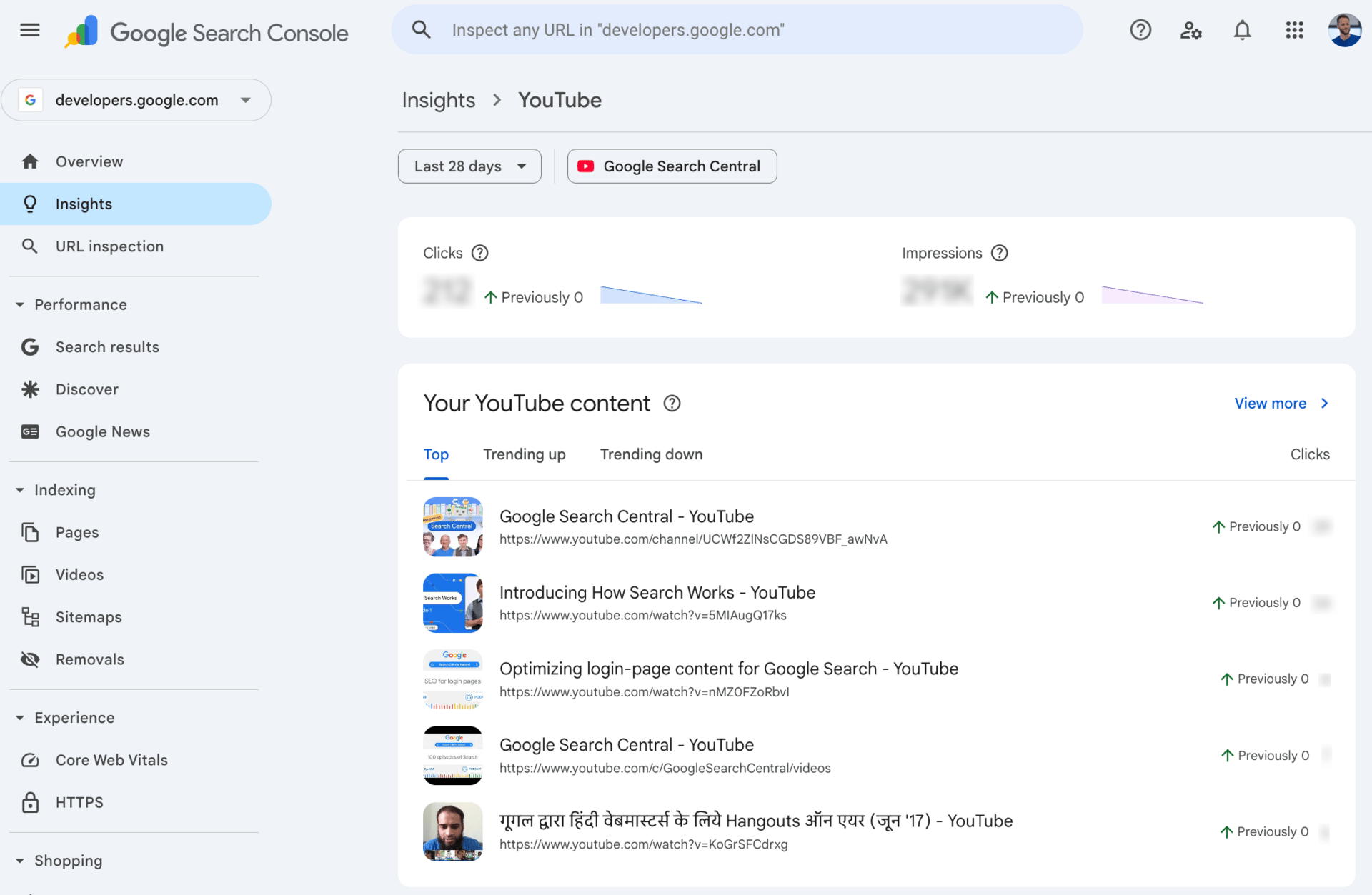
Google introduces a new Search Console experiment that finally connects website and social performance in one place. Google wants brands to think beyond websites. Google is expanding the Search Console Insights report to include data from select social channels, starting with platforms like YouTube. Site owners can now see clicks, impressions, top content, trending pages, search queries, audience countries and even how social traffic compares with Discover, Images and Video Search. The rollout is limited and automatic for now.
Louise Linehan and Xibeijia Guan analyzed 75,000 brands to see what drives mentions in ChatGPT, Google AI Mode, and AI Overviews. The loudest signal: YouTube. More brand mentions in video titles, transcripts, and descriptions correlate most with AI visibility, even more than links or sheer content volume. Next, earn real web mentions and branded anchor text across reputable sites. Classic authority metrics like backlinks and Domain Rating matter less, especially in ChatGPT, which may be easier for smaller brands to crack. If you want AI mindshare, invest in video presence, PR that earns citations, and partnerships that spark name-linked references.
Vincent Terrasi argues that ChatGPT visibility is rising while referral traffic collapses, based on a ChatGPT partner report that tracks impressions, clicks and where links appear. Main answers generate huge exposure but tiny CTR, while sidebars and citations earn the best clicks. His advice is to optimize for being included in answers, not visits. Tighten your entity footprint with consistent names, Wikidata/Wikipedia presence and strong schema. Lead with clear facts, sources and author credentials. Keep pages updated for long-term accuracy. And pick the few query types where clicks still happen, like comparisons, specs, news and how-tos.
Rob Glover reports that SMB traffic is splintering, so your site must earn clicks and conversions fast. In his survey of 300+ businesses, social drives more visits than SEO (64% vs. 52%), yet 72% still say SEO works. The top pain point is not content, it is getting qualified visitors and turning them into leads or sales. His advice: tighten tracking, build conversion-first pages with CTAs, and keep your Google Business Profile and listings accurate. For GEO, use clear headlines, improve readability and speed, add structured data, and encourage brand mentions.
Glen Allsopp dug through ChatGPT answers for 750 top-of-funnel prompts and found “best X” listicles dominate citations, making up 43.8% of sourced page types. Freshness matters: in his sample of 1,100 lists, 79.1% were updated in 2025, with 26% updated in the last two months. Ranking higher on third-party lists correlated with being recommended more often, especially in the top third of lists. He also flags a risk: many cited lists live on low-authority, sketchy domains.
Lazarina Stoy explains how AI search turns one query into dozens of subqueries, then stitches the results into a single answer, which can bend intent through personalization and semantic drift. The fix is not more pages or more links. It is clearer, chunkable content built around entities, attributes, and real user journeys. Write passages that stand alone, answer specific facets, and connect related concepts with clean structure and schema. Track success by mentions and citations in AI answers, not keyword rank. Cover transitions from research to purchase to troubleshooting so you stay retrievable as queries fan out.
Tushar Pol ran a simple test on the Semrush blog: publish 81 new FAQ-style pages, then track when Google’s AI Mode and ChatGPT Search cite them over 30 days. Google AI Mode moved fast, citing 36% of pages within 24 hours and peaking at 56% by day seven, but citations were volatile and fell to 26% by day 30. ChatGPT Search started slower, citing about 10% on day one, but it kept adding pages and held citations more steadily, reaching 42% by day 30. Practical takeaway: optimize for speed and churn in AI Mode, and patience plus consistency for ChatGPT.
My Take: I’ve actually experienced ChatGPT citing my pages faster than AI Mode 😅
SEO + GEO Ripples
Google Search is pushing harder to connect users with trusted websites. Preferred Sources is rolling out globally, letting readers tune Top Stories toward favorite outlets and, Google reports, doubling clicks to them. A subscriptions feature will highlight stories from publications you pay for, starting in the Gemini app. Google is adding more inline links in AI Mode, plus quick notes on why a link matters. Google is piloting publisher partnerships in Google News, testing AI overviews and audio briefings with attribution.
Roger Montti reports that the European Commission has opened an antitrust inquiry into whether Google uses publisher content to power AI Overviews and AI Mode without compensation or an opt out. The worry is simple: publishers may feel forced to accept AI summarization because opting out could mean losing Search traffic. The probe also targets YouTube, where creators allegedly must allow Google to use uploads to train generative AI, with no payment, while YouTube policies block rival AI firms from doing the same.
AI
OpenAI releases GPT-5.2 that sets new highs across professional and technical benchmarks, especially where long, messy work breaks weaker models. On GDPval, it beats or ties human experts on 70.9% of real knowledge work tasks like spreadsheets, planning, and presentations. In software engineering, it reaches 55.6% on SWE-Bench Pro and 80% on SWE-Bench Verified, showing stronger end-to-end debugging and feature delivery. It also cuts hallucinations by roughly 30% in factual tests and leads on long-context evaluations, staying accurate across hundreds of thousands of tokens.
AI Ripples
OpenAI reports a three-year licensing deal with Disney that lets fans generate short, shareable videos in Sora using characters from Disney, Pixar, Marvel and Star Wars. The move signals how major IP holders plan to work with generative AI instead of fighting it. Disney will also use OpenAI’s APIs across products like Disney+ and deploy ChatGPT internally, while investing $1 billion in OpenAI. The agreement stresses guardrails: no actor likenesses or voices, strong safety controls, and respect for creator rights.
Google is launching fully managed, remote MCP servers so agents can connect to Google and Google Cloud services through consistent endpoints, instead of brittle, self-hosted setups. The first wave includes Maps Grounding Lite for fresh place, weather and routing data, BigQuery for in-place querying and forecasting, plus Compute Engine and GKE for infrastructure and container operations.
Disco opened the waitlist as a Google Labs experiment that turns your tab chaos into a purpose-built mini app. GenTabs reads your open tabs and chat history, then generates interactive tools for the task at hand, no coding required. Describe what you need, tweak it in plain language, and every output keeps citations via links back to the original pages. It can suggest apps you did not think to ask for, based on what you are researching. Join the waitlist on macOS.
Google Translate is getting a Gemini-powered upgrade that makes tricky phrases feel human, not robotic. If you translate idioms or slang, try the text translations rolling out in the U.S. and India across English and nearly 20 languages. Traveling or watching content abroad? Tap Live translate, plug in any headphones, and get real-time speech-to-speech translation that keeps tone and cadence, now in beta on Android in the U.S., Mexico and India.
Content
Floyi research looks at a question most pricing comparisons avoid: what does it actually cost to ship an article that’s ready to publish, not just generated. The piece breaks costs down beyond drafts, showing how rewrites, intent fixes, missing entities, and structural cleanup quietly inflate “cheap” AI content. The core argument is simple and uncomfortable: content budgets don’t break on generation, they break on reconstruction. The practical takeaway is to measure cost per publish-ready article, standardize upfront briefs, and treat rewrite time as a KPI rather than an afterthought.
Treat “publish-ready” as the unit: 1 brief + 1 draft, not “words generated.”
Use this formula: (monthly cost + usage fees) ÷ publish-ready articles shipped.
A 30–60 minute rewrite can add roughly $20–$80 per article at $40–$80/hr.
A 45-minute rewrite at $60/hr adds about $45 to the true article cost.
Human-written baseline (1,500 words): $75–$150 entry, $165–$375 mid-level, $450–$750+ specialist.
Editing can add $30–$120+ per article depending on depth and rate.
Normalize tool comparisons with fixed throughput scenarios like 20 vs 200 articles/month to avoid “unlimited” hype.
Prioritize briefs that include SERP patterns, intent alignment, entity depth, and internal linking cues to cut rebuild work.
LINK BUILDING / PR
Vince Nero analyzed 16,000 PR campaigns and 5 million BuzzStream outreach emails to settle a pitch debate: send from an agency domain or a brand domain. Agency addresses earned about 15% higher open rates, mostly because agencies write sharper, more urgent subject lines. Brand domains, however, produced 60% more replies, likely because the sender feels more credible and recognizable. The best combo was agencies emailing from the client’s brand domain, which topped both opens and replies.
SOCIAL MEDIA
Pinterest Newsroom reports that Pinterest Predicts 2026 is a peek at what people will search and shop next, built from year over year signals and said to be 88% accurate. The big themes are comfort, curating not copying, and grounded optimism. You can turn this into a content calendar: build “nostalgia plus now” stories, launch personalization friendly guides, and create creative prompts that invite remixing. Test trend led keywords and visuals such as Pen Pals, Cabbage Crush, Glitchy Glam, Neo Deco, and Mystic Outlands. Treat each trend as a mini audience segment, then ship fast landing pages, pins, and emails.
WAYS WE CAN WORK TOGETHER
Floyi - The only AI-powered tool that builds 4-level topical maps. Don’t just plan your content strategy - make it unstoppable.
TopicalMap.com Service - Let us do the heavy lifting. We handle the research, structure, and strategy. You get a custom topical map designed to boost authority and dominate your niche and industry.
Topical Maps Unlocked 2.0 - Unlock the blueprint to ranking success. Master the art of structuring content that search engines (and your audience) love - and watch your rankings soar.
AD
Why AI Isn’t Replacing Affiliate Marketing After All

“AI will make affiliate marketing irrelevant.”
Our research shows the opposite.
Shoppers use AI to explore options, but they trust creators, communities, and reviews before buying. With less than 10 percent clicking AI links, affiliate content now shapes both conversions and AI recommendations.
LIKE DIGITAL SURFER?
Find me and others in the Digital Surfer Discord community.
I’d also love to know what you think and if you have any ideas for the newsletter. Reply or email me at [email protected].
I’d also appreciate it if you shared it with fellow digital surfers.
{{rp_personalized_text}}
Have a great week taking your SEO and digital marketing to another level!
And don’t forget to drag the Digital Surfer emails to your Primary Inbox 🌊
Reply